Showing posts with label Bill Sutton. Show all posts

Tuesday, November 20, 2012

Hiding in plain sight

Sometime around the middle of the 1960s, artist Bill Sutton used to fly regularly between Christchurch and Wellington. He'd been appointed to various national art committees; this was the moment when New Zealand high cultural infrastructure for the visual arts was starting to be built. On his way to and from the meetings, he'd look out of the window of the plane, the ochres and umbers and deep shadowy violet-greens of the Canterbury plains framed by the curve of the cabin. "When you look down from a plane there is no right way up," he commented. "it becomes pure pattern. I saw bands of clouds below the horizon, and sometimes no horizon at all. This medley evolved into many paintings and one major series." [1]

W.A. Sutton, Plantation Series II, 1986, oil on canvas, Collection of Christchurch Art Gallery

As a lecturer, Sutton was prone to tipping up works, holding them upside down so that the composition could be considered from another angle, so that subject matter would not get in the way of looking. The painting was always to be considered as a composition before it was considered as a window on to the world beyond the work. But when Sutton felt that he was skirting too close to abstraction, he pulled back. He was concerned that abstraction would become an end in its own right, a form of decoration. He worried that art-about-art, rather than art-about-experience, was essentially an arid pursuit, as dry and as unsustainable as the burned-off grasslands which became his characteristic motif.

W.A. Sutton, Murals, Waikari, 1951, oil on canvas, Christchurch Art Gallery

At much the same time as he was flying to Wellington and back on the business of art, Sutton had moved into his house near the river in Richmond, Christchurch, designed for him by his friend and colleague, the modernist sculptor Tom Taylor. The scale of Sutton's work changed. Painting in a big room -- a combined studio/living space, with a bank of high windows on one wall, and a view out to the garden through the other -- meant that he could construct larger canvasses, and work on more of them at once. The Grasses series, and later the huge Plantation works, with their aerial views of the Canterbury plains, and the Land Synthesis series with their sense of the landscape viewed at great speed, were painted in this studio.

W.A. Sutton, Landscape Synthesis, oil on canvas, 1980

I fly to and from Wellington on the business of art sometimes myself; I can never look out of the window of the plane at the patchwork of fields below without thinking of Sutton's Plantation series; and without thinking of Sutton himself, his face pressed against the glass of the small thick windows of the old turbo-prop planes, scanning the horizon for significant forms. In his notebook perhaps a sketch for a drift of cloud, a curve of hill, the remains of a vapour trail against an impossibly blue sky, a grid of lines describing the bleak hard fastnesses of the Canterbury landscape. Seeing the world as a work yet to be painted.

W.A. Sutton, Threshold IV, 1973, oil on canvas, Collection Christchurch Art Gallery

When Sutton flew over the plains, and incorporated their characteristic forms into his work, he drew, perhaps, on his experiences during World War II as a member of the Camouflage Unit. Between 1941 and 1944 he had moved around the South Island digging post holes and designing and painting camouflage to hide gun emplacements and ammunition stores. The job was "to make things look like other things". These utilitarian paintings, designed to be seen from the sky, to hide things in plain sight, were often gigantic in scale.

"I remember we disguised an airfield at Taieri, Dunedin, by extending the appearance of paddocks and hedgerows into the airfield itself  ... with bleaches for grass and manure to intensify the colour ... it was so good, our chaps couldn't find it," Sutton commented, forty years later.[2] 

Sutton's familiar view of the Canterbury landscape will change with the introduction of water consents for intensive dairying across the plains; his burned-off dry grasses, shaded by the long dark shadows of the macrocarpa shelter belts, will be replaced by patches of bright jade green. Sutton's aerial landscapes, the structures of ochre and umber and indigo which hover between abstraction and representation, and which for so many people are synonymous with the experience of flying in to the city over the plains, will be relegated to a historical report on experience. Like the paintings which depict it, the landscape is itself a cultural artefact, vulnerable to the forces of market productivity. Although it's part of our cultural identity, the look of our home landscape is as little owned by us as the architectural heritage of our cities.


1. Bill Sutton, 'Personal Perspectives', in Pat Unger, W.A. Sutton: Painter, Christchurch: Hazard Press, 1994, p.46.
2. Bill Sutton, interview with Deborah Shepard, 1982, quoted in Pat Unger, Bill's Story: A Portrait of W.A. Sutton, Canterbury University Press, 2008, p.52.

Thursday, July 1, 2010

Lino Types

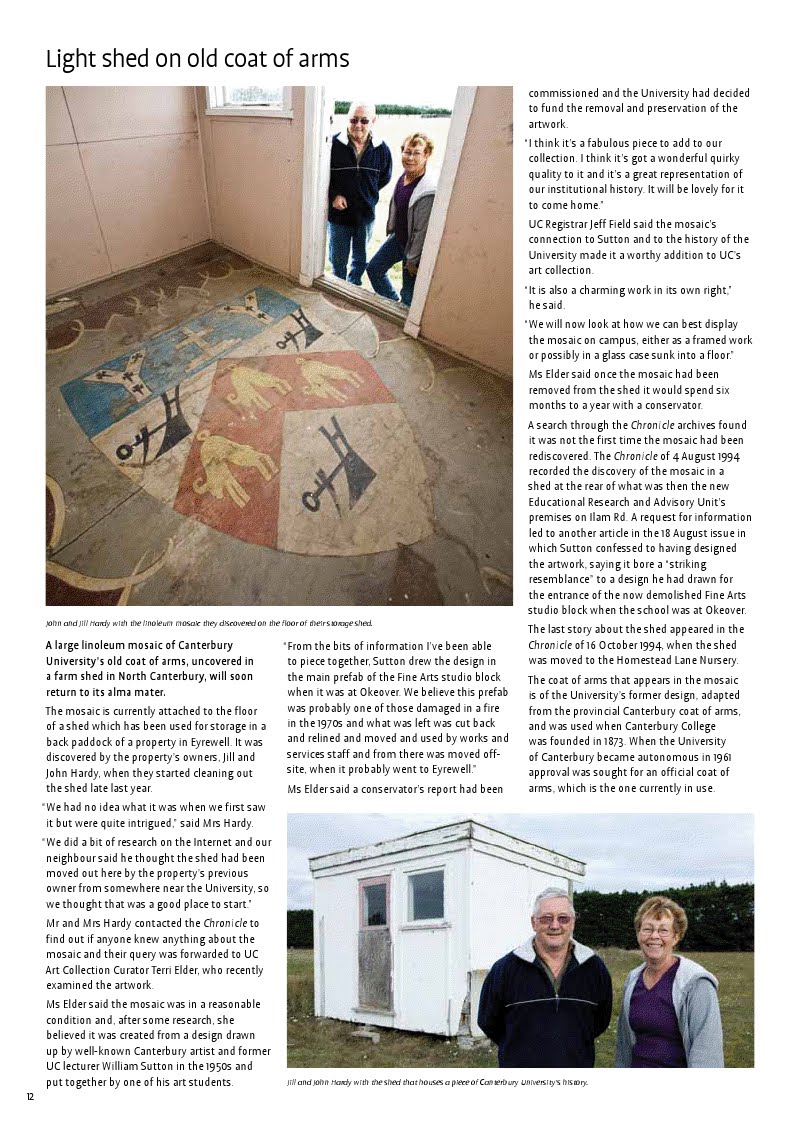
There was news of an interesting cultural discovery the other day in Canterbury: the old coat of arms of the University of Canterbury, designed by the artist Bill Sutton and made in lino by Sutton and his students from the School of Fine Arts in the 1950s, has been painstakingly restored by conservator Emily Fryer after being found in a shed.


The shed, on a private property in Eyrewell, was believed to have been constructed from part of a pre-fab in which the art school was housed at the Ilam campus (the art school was famously the first department to move from the town site, and the last department to receive its own purpose-built accommodation).

Here's a photograph of the original building, after the catastrophic fire which gutted it in 1975:


And an image of one of the lecturers' offices (more photographs at Digital NZ):


In its restored state, the coat of arms includes a burn mark, presumably dating from the art school fire. It seems to have originally been designed by Sutton for the floor of the art school's entrance, and was superseded in the early 1960s when the University became autonomous and changed its crest. Thereafter it's been lost and found a few times over the years in various sheds around the university campus, but following its restoration is going to be formally accessioned into the University's art collection, and is likely to be set into the floor in one of the new buildings at the Ilam campus. It's good to see the university treating its own art history with such care and seriousness, and I'm looking forward to seeing the coat of arms when it's exhibited later this year.

It reminded me a great deal of the similar crest set into the floor of my old high school, featured in Peter Jackson's Heavenly Creatures. As I remember it, the shot showed the girls' lisle-stockinged legs and clumpy brown shoes flowing like water around the crest: they were forbidden to tread on it, as were we, forty years later. (So of course everyone did walk over it, whenever they could get away with it.) I don't know who designed and made Girls High's one, which is still set into the floor in the old building, now used as a community facility: the ribbon is nice, but it certainly doesn't have the attenuated elegance of Sutton's design for the university. Wisdom and truth girls, wisdom and truth. And get your dirty great feet off the crest.


Image from Heavenly Christchurch.

Sunday, June 20, 2010

Cultural Fogeyism

Frances Hodgkins, Pleasure Garden, 1932, watercolour, Collection of Christchurch Art Gallery Te Puna o Waiwhetu


The Pleasure Garden Incident -- as it's known to history, like the title of a novel Robert Ludlum deemed too fruity for publication -- tore a mighty rift through Christchurch's art world of the late 1940s.

Following Frances Hodgkins's death in 1947, the British Council sent six of her late works to the Canterbury Society of Arts for exhibition and potential purchase. Nearly three years of ridiculous argy-bargy ensued, as a battle was fought over the purchase of a single work, the Pleasure Garden. The progressive and conservative camps of the local art scene squared off against one another in public meetings and the correspondence pages of the newspaper, while the general public looked on with indignation and incredulity. The Garden City continues to use this method to conduct its cultural affairs: the Arts Centre's Heritage Carpark, anyone?

On the one side of the Pleasure Garden stoush were the go-ahead artists like Doris Lusk, Theo Schoon, Olivia Spencer Bower, Colin McCahon, and William Sutton, who wished the city to have the work. On the other were the keepers of what McCahon described in a vituperative letter to the paper as the 'three dead tombs of art' (the university's art school, the city's public art gallery, and the local art society); whose spokesperson, painting lecturer Cecil Kelly, suggested of Hodgkins's work that "The tone is not good. The colour is not good. And the composition is all over the place. A child could do it."

(Mind you, the progressive types were just as incendiary: one described the city's Robert McDougall Art Gallery as "a badly arranged museum of Victorian art ... that had died when photography came in", while another apostrophised Christchurch itself as a "curious and amusing backwater in the world of art".)

In yesterday's Press, Michael Vance looked at the incident in his 'The Way We Were' column, concluding that the row was not over one painting, but represented something much larger.

"It was the moment when cultural fogeyism, which had dominated Christchurch art since the colony's foundation, was first defeated, and, despite occasional stirrings, it has remained defeated."


And there we have it. Christchurch, New Zealand: free of cultural fogeyism since 1951.

Tuesday, August 18, 2009

Unhomely

I've written before about the way certain artists come to completely own the landscape they live and work in. I can't see photographs of Long Island, for example, without the view rearranging itself into an Edward Hopper painting: I've had Ed Ruscha moments in L.A., driving past anonymous motels and gas stations; in Christchurch in the spring and summer, there are weeks on end presided over by Bill Sutton skies.

William Sutton, Plantation Series II, c.1985, oil on canvas, Collection of Christchurch Art Gallery

There's such a characteristic feeling of uncanny displacement when you come across a scene in the real world that you already know from an artwork. (Probably the most memorable occasion of this for me was entering New York at night for the first time, riding in the back of a yellow cab with steam rising from vents in the road, having watched Taxi Driver 200 times previously at home in New Zealand.) Less often it can happen with objects: I can't see old road signs or enamel-ware now without thinking of Rosalie Gascoigne, or arrangements of wine glasses on a table without recalling Bill Culbert's photographs taken at his home near the Luberon.

These moments when the real world gives way to the artwork are intensely familiar, yet at the same time out of place, transporting you between the actual and the virtual and back again in the blink of an eye. Not only does an artwork motion you towards a particular way of seeing, it also invites you to focus on the kind of singular detail that gets lost in the maelstom of daily life. I think these experiences are among the most rewarding of the art life.

Walking back from school this morning it happened twice.

First I saw a Gavin Hipkins in the park.

Left: Gavin Hipkins, The Homely: Sydney (Flower), 1999, back cover of catalogue.

And then why, I wondered foolishly as it turned out, are they illustrating a Simon Morris painting on a real estate sign? A house of art collectors?

Left: Simon Morris, Protein, 1993, acrylic on aluminium, Chartwell Collection, Auckland Art Gallery Toi o Tamaki. Right: The QR Code on a Harcourts Real Estate sign in Leinster Road, Christchurch.

I'm interested here not only in the way that experiences of the real world are mediated by works of art, but the way in which an encounter with a work of art can be enlarged by seeing its equivalent in everyday life. This traction between the familiar and the strange, the actual and the virtual, is what the experience of a work of art is all about, it seems to me.

Monday, March 23, 2009

Famous for something or other

Gerard Malanga, Ingrid Superstar and Andy Warhol (1966). Photo: Nat Finkelstein. via Warholstars

'In the future,' said Andy Warhol -- though later on he wished he hadn't, as it was boring always being asked about it -- 'Everyone will be world-famous for 15 minutes.'

Warhol made that prediction back in 1968, when private lives were still relatively private, and when most people -- apart from those chosen few lifted to celebrity status by virtue of extraordinary talent, or great good looks, or perhaps the misfortune to be caught up in a major criminal trial -- lived out their lives in relative obscurity, socialising only with a discrete group of family and friends. Today, of course, thanks to the ubiquity of digital imaging technologies and the unstoppable rise and rise of online social networks like Twitter and Facebook, people's lives are lived far more publicly, with friendships and intimate relationships often conducted in full public view. There's a seemingly insatiable public appetite not only for news about celebrities but the desire to live as one, in the public eye. I'm not sure exactly what the generational uptake is for digital social networking, but it seems predominantly a younger person's game; I suspect a birthdate of 1968 might roughly signal the upper age limit of the socially-networked contemporary individual.

Andy Warhol was fascinated by the media's ability to create something out of nothing, and was adept at using it to explore his ideas of celebrity. His entourage of hangers-on, whom he named the Superstars, became famous for not actually doing very much at all except hang around at the Factory and go to nightclubs with Warhol and be fabulous on cue for his camera. After a short time in the spotlight, most faded away to obscurity, while others simply disappeared or died. When you think about it, Andy Warhol's Superstars might well be considered the first of the reality media stars: there's a direct line of descent between them and the unfortunate British reality TV celeb Jade Goody, who passed away from cervical cancer in the weekend aged 27, having spent much of the past few years, including her final difficult weeks, in the public eye.

Jade Goody, via The Himalayan Times

I got quite grumpy this morning listening to Mike Hosking grumbling on about how Jade Goody was unaccountably famous for doing nothing at all, as if she were merely a tiresome symptom of some kind of contemporary social psychopathology; a vulgar dimwit hardly worthy of an intelligent person's attention. I've been in front of the cameras a few times myself, and it's hard work; it's not an easy thing to do at all, to turn it on on demand. You could film a thousand people picked at random off the street and none would have been as entertaining or as watchable as former dental nurse Jade Goody. (Certainly not me.) Irrepressible, irreverent, warm-hearted, unpredictable: a hugely enjoyable personality. Her famous gaffes ('Where's East Anglia? Abroad?' and 'Who's Rio de Janeiro?') were all part of the schtick: it's unremarkable to be ignorant, but it is remarkable that a public staging of a private self can achieve and sustain such a gigantic audience. (A far larger one, of course, than Hosking receives on the radio. Where his job is similarly to open his trap and bang on about nothing.)

In celebrity news closer to home, the twelve bronze heads ('Christchurch Heroes') have finally been installed in the Christchurch Arts Centre to considerable fanfare in the newspaper. (Images here and here.) While it's a well-intentioned gesture to mark the achievement of some outstanding individuals and to value local history, I have nothing to say about these works as public art (that's not the point of them, I wouldn't have thought), apart from noting that there are already a lot of public memorials in Christchurch: oddly most of the individuals depicted here are still very much in the land of the living.

Here's Canterbury Heritage's take on the selection:
'Said to be of worthies who are among those whose achievements in the second half of the twentieth century are remembered with pride and pleasure by the people of Christchurch, we note with interest that more than half of those enshrined gained this alleged distinction through the world of commerce.'
On the other hand, Over The Net are surprised that the two arts figures among the group, painter Bill Sutton and children's author Margaret Mahy, have been named as local heroes at all, suggesting that the selection posits that 'heroism is simply an extension of celebrity'. Which is an interesting point, I think. (Though at the same time I do believe Sutton is a bit of an unsung hero of New Zealand modernist art. He should be considered a national figure of similar status to Toss Woollaston, rather than just a regionalist of note. Not that displaying his bronze head on a plinth in Christchurch will do much about that problem.)

I was interested to read somewhere that the twelve bronze busts, commissioned by a private trust, have only been granted a ten year 'lease' on their spot near the Court Theatre. After that point, their permanence and continued relevance to the site will be reassessed. One man's decade is another's 15 minutes, perhaps.

Wednesday, January 28, 2009

Museum merch

It's not very widely known, but Canterbury Museum has quite a good art collection. (The bulk of Christchurch's art collection is housed at its public gallery.) Most of the Museum's art holdings are historical, of course, and relate to the early days of the Canterbury settlement; but there are also some great contemporary New Zealand works tucked away, including a silver epergne by Tony de Lautour and a series of Michael Parekowhai's kowhaiwhai lightboxes permanently hung in the research library.

When Canterbury Museum's rebuilding project was put on hold in 2006 after being declined resource consent (the plans involved architectural changes made to the A-listed historic building designed by Benjamin Mountfort), its proposal to take over the old Robert McDougall Art Gallery building next door, which had recently fallen vacant due to the building of the new gallery, also foundered. The plan, as I understand it, was to use the beautiful old neo-classical gallery building for temporary and touring exhibitions, and also to exhibit what the museum until quite recently quaintly referred to as its "Picture Collection". (Can't find any reference to that on its website -- but then there's hardly reference to anything much at all. Time for an upgrade, chaps.)

Anyway, in conjunction with the Ellerslie Flower Show in Hagley Park later in the year, the Museum is using the old gallery building to exhibit the complete set of Banks' Florilegium, the engravings made from the botanical specimens collected by botanists Joseph Banks and Daniel Solander on James Cook's voyages of exploration, including from the Endeavour's landfalls in New Zealand. Painter Bill Sutton donated funds to the Macmillan Brown Library at the University of Canterbury to purchase the set of prints, one of only 100 in the world: the university has a short article about the collection here. (The festival publicity about the show suggests that it's the first time they've been publicly exhibited in Christchurch, but that's rot: I saw them in the 80s. Won't stop me going along to see them again, though.)

I very rarely make impulse buys from the supermarket, but when I saw these vegetable chips the other day, I had to have them. In a triumph of the copywriter's art, the manufacturers note: "We have drawn inspiration from Sir Joe and his insatiable appetite for adventure to develop our range of incredible taste experiences." Excellent stuff. Perhaps the Museum could snap up a caseload for the gallery shop.

Wednesday, October 15, 2008

Modern Gothic


Years ago, I visited the artist Bill Sutton at his house in Richmond, Christchurch. I went to interview him about the Christchurch art scene in the 1960s, in which -- as in several other decades, too -- he was a major figure, variously as a teacher, practitioner, and champion of both the arts and fellow artists.

The house was fantastic: like the man himself, compact, modest, unassuming, well put-together. We sat in the lounge on low modernist chairs with wooden arms, facing a tiny conservatory area festooned with well-tended plants. I remember that after a while Bill brought out tea and biscuits: he turned the plate so that the pink wafer biscuits faced me, and smiled. "Perhaps you might like these," he said.

I did.

The photo above shows Bill's house (via the excellent and often enjoyably vituperative Canterbury Heritage site), and gives an idea of the equally significant garden in the modernist style which he designed and planted. The house itself was built in 1961, but I'm not certain of the architect. The 1960s were one of the great decades in Christchurch architecture. The city's best mid-century modernist architect, Paul Pascoe, was still working; while a new generation including Ian Athfield, Miles Warren, Maurice Mahoney, Don Donnithorne and Peter Beaven were beginning to make their marks on the city scape, developing a distinctly modern and brutalist architectural style which at the same time acknowledged the region's vernacular building history, with tall chimneys and sharply pitched roofs.


Rita Angus, The artist’s cottage, Clifton c.1945, watercolour and pencil, 240 x 273 mm, Collection of Te Papa Tongarewa, on loan from the Rita Angus Estate. Image from Christchurch Modern.


For fans of modernist architecture, there's a new-ish site devoted to the Christchurch Modern with brief profiles of some of the key architects of the Christchurch Style, as well as contemporary photographs of their domestic work. Highlights so far for me (people are being encouraged to send in images of other houses) include Rita Angus's house on Aranoni Track, Clifton, designed by Paul Pascoe and pictured by Angus above; the prototype "Noddy" houses in Queens Avenue, built by Miles Warren for his parents; and Pascoe's much-loved Piano House in Sumner.

I really hope that the appreciation which people increasingly have for the modernist period of New Zealand's design history results in greater protection for its iconic examples than has been meted out to earlier domestic architecture.

Friday, August 29, 2008

Slow local

Edward Hopper, Highland Light, 1930, watercolour over graphite on rough white wove paper, Collection of Harvard College


I've written before about the way in which certain artists come to "own" the views which inspire their work, to a point where it's almost impossible to see a particular landscape except through their eyes. Think of Edward Hopper's Cape Cod landscapes; Ed Ruscha's LA; Arthur Boyd's Wimmera. There are dozens of New Zealand examples: Toss Woollaston's high vantage point across Wellington Harbour, which he experienced in a sort of muddy atmospheric cubist frenzy, and accordingly now so do I; McCahon's tablet-like clifs at Muriwai; the slight edge of craziness in the swirling skies of Bill Sutton's rural Canterbury churchyards; the surprising delicacy of Bill Hammond's Boulder Bay in Lyttelton Harbour, with its whispy birds and plumes of spray; the doughty resoluteness of Michael Smither's stony Taranaki beaches banking up his glimpse of the mountain.

Years ago I was driving through Provence when I saw a familiar landscape appear like a mirage in the distance. "It's Mont Sainte-Victoire!" I said excitedly. "You know, that mountain Cezanne painted a lot." Until I saw it I'd had no idea where it was, or even, stupidly, that it was a real place: I'd never thought about it. I felt ridiculously pleased: seeing the view framed in the windscreen was like owning my own personal version of the paintings, until the road turned a corner and it was out of sight.

The extraordinary thing was that what I saw from the car looked just like the paintings, an arrangement of angles and planes and edges softened by a golden haze. I wasn't long out of university and had "done" Post-Impressionism twice, once as part of a stage one French culture course and again as part of Art History (bet it doesn't feature much in either today). Of course everything was taught by slides: there were no real works of art to look at. Driving through the French countryside I realised that my understanding was completely at fault, and that Cezanne, at least, was much more of a realist than I'd hitherto assumed. (Ditto Hammond, when I took a walk down to Boulder Bay.)

On a visit to Christchurch once, I had a similar experience of encountering a landscape I was already familar with from a painting. I was driving through the old streets of the eastern central suburbs, trying to find an acquaintance's studio, hopelessly lost. Going through an intersection, I looked to the right towards the hills, and suddenly saw Doris Lusk's Pumping Station. It looked exactly like the painting. Just as suddenly, it was gone, and I've never seen it again.

Doris Lusk, The Pumping Station, 1958, oil on board, Collection of Auckland Art Gallery

Built in 1882, the Christchurch Pumping Station (it pumps the city's sewage along the pipes out to Bromley) is now a protected building. The city council with the poorest record in the country of granting non-notifiable resource consents (effectively letting developers knock stately old buildings down before anyone else finds out about it) couldn't knock it down, even if it wanted to: Lusk's view is safe. (Now, if only I could find it again!)

But not so Edward Hopper's view of Highland Light and the keeper's house at Truro, Cape Cod, which inspired so many of his works. The NY Times has a piece about the zoning consent which has just been granted to owners of the section next door to the house once owned (and designed) by Hopper and his wife Josephine, to allow them to build a 6,500-square-foot trophy house, which will effectively block the barren view made into one of the iconic images of American art by Hopper. It's being done in the teeth of opposition from local residents, who say there are two types of people that traditionally live in Truro: fishing people and artists, and landmarks are important to both.

It's a vain hope, I guess, to suggest that landscapes which artists have made famous should be protected from development. But in this instance, it does seem a bit of a pity.


Hopper used to drive around the Cape a lot to find locations to paint; he often painted from his car, a two-tone Buick sedan, in which he had had the green-tinted windshield and windows replaced with clear glass. An article in Time magazine in December 1956 in which he was interviewed at his Truro home commented that his paintings look as if the viewer is travelling, somehow:
"By suppressing all details that would not be noticed in a passing glance, and arranging his compositions to suggest that the scene extends far beyond the frame, he puts his picture window in motion. Seeing a Hopper exhibition is like floating through people's backyards on a slow local, in a state of awed awareness."

Unlike the new neighbours, one of the current owners of a house painted by Hopper says she feels an obligation to keep the house as it was, given the numbers of people who come to photograph and paint it themselves, following Hopper's trail around Truro. You can compare the paintings with the locations as they are today in this New York Times feature: or click here for an interactive 360 degree video view from the Hopper house. Might not look like this for much longer.