Showing posts with label Jeff Koons. Show all posts

Wednesday, June 30, 2010

Hammond Eggs

Andy Warhol had soup for lunch every day for 20 years. His favourite home-cooked dinner was turkey and potatoes, "because it looked so simple and clean". Picasso liked ancient eggs, stilton and preserved ginger. Edward Hopper was partial to "cans of the friendly bean". Jeff Koons served his favourite food, tuna burgers, at his 50th birthday party. And while Louise Bourgeois had a lifelong fondness for the humble oxtail, at one point in the 1990s Tracey Emin was on 70-100 oysters a week.

What these artists' snack preferences have in common (with the possible exception of Louise Bourgeois's, as oxtail takes a bit of stewing; but then again she was extremely well-organised) is a lack of fuss and no need for lengthy preparation. As Jo Hopper, Edward's wife, told the compiler of a Greenwich Village cookbook who'd approached them for a recipe: "We feel that where there's too much fussy cooking there isn't so much painting."

In a similar vein, here are two tasty no-fuss snacks enjoyed by Lyttelton's favourite son, the artist Bill Hammond, and Jane McBride. I do like to think of Buller's Table Cloth being painted with the help of a fortifying beetroot buttie.


From Harbour Kitchens: Celebrating Lyttelton, Its Food and Its People, Lyttelton Main and Lyttelton West Schools, 2009. Introduction by Roy Montgomery.

Thursday, August 6, 2009

Art history, Koons-style

Jeff Koons, Girl with Dolphin and Monkey (The Whitney Museum of American Art 75th Anniversary Photography Portfolio), 2006, chromogenic crystal archive print.
'I’m so involved in contemporary art myself that I’m much more interested in art from a different time. I have a little bit of a sense what it’s like to be alive today, to try and make work today, so contemporary art isn’t so important to me. I’m more interested in what it meant to be alive, to be trying to make art, in other times, in a very different culture.'


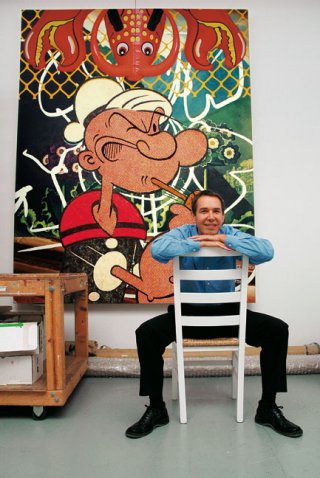
Jeff Koons in front of Popeye (2003, oil on canvas) at his Chelsea studio, New York 2003. Photo: Catarina Åström.

'Each of these broad sweeps is hand-painted with very small brushes, we never use sponges or anything larger. The whole art work is a gesture and all these gestures are about doing something with your life, about what you really want to do. This is very fluid, at a distance you can see the imagery, but up close it is very abstract. They’re about [the] history of European art. I love it when there’s a revelation in art, when you see things you have not seen before, connections that you make yourself, not that you’re supposed to make, when those things are there for you. There are French 19th-century brushstrokes we’re painting alongside the Magic Marker lines ... they really work together.'

Both quotes are Jeff Koons, interviewed by Adrian Dannatt in The Art Newspaper.

Wednesday, July 1, 2009

Older than Elvis


The big guy said something interesting the other day. (I should stress that this event in itself isn't the point of this post: he is often quite interesting, both on and off his specialty subjects.) We were talking about the extraordinary outpouring of emotion on Twitter and in the old media about the death of Michael Jackson. I was quite surprised about it, probably because I haven't thought anything he'd sung since Billie Jean is much chop. The big guy, however, pointed out that I'm swimming against the stream of 750 million album sales, which would mean that quite a lot of people do think Michael Jackson is reasonably good.

So then I thought about the celebrity deaths which have been meaningful in some way to me.

1. Elvis 1977
2. John Lennon 1980
3. Ian Curtis 1981
4. Princess Diana 1997 (cough cough; no excuse for this really)

And of these, of course, the greatest and most significant was Elvis.

'Do you think Michael Jackson was the black Elvis?' I asked the big guy, and also put it out for consideration on Twitter: the answer from both sources was a resounding no. In a royal smackdown between the King of Rock 'n Roll and the King of Pop, 'Presley', as my father always referred to him, would take care of business on all fronts.

When I wondered aloud if the estimable Harry Hutton might be correct in his assessment that 'Michael Jackson touched the hearts of simpletons everywhere', ('No display of ass-hattery will be judged excessive in the coming days. If Blair himself read a prayer at Jackson's funeral then led the congregation in an embarrassing dance, I would hardly wince'), the big guy suggested that it was more likely to be an age thing. 'People affected by Michael Jackson's death are too young to remember Elvis's,' he said.

Comparisons, though odious, are also quite interesting as well as being good money-spinners for hack writers, and someone's bound to do a fine job pulling together all the links between Elvis and Michael Jackson: the entourages, the crazed shopping sprees, the prescription medicines, the odd relationship with food, the physical wreckage, Lisa-Marie.

Michael Jackson certainly had the comparison in mind. I came across this sad quote from his 1998 memoirs: 'The way Elvis destroyed himself interests me, because I don't ever want to walk those grounds myself.' Which is just inviting any number of sappy feature articles lambasting the cruelty of the global capitalist celebrity mincer machine and referring to butterflies broken on the wheel, candles in the wind, etc etc. (In the midst of all the emoting, however, I was pleased to hear that Bubbles the chimp is doing it easy 'listening to flute-and-guitar music' away from the media spotlight at a sanctuary in sunny Florida. Damn shame someone who cared about him couldn't have got Michael Jackson to one, as well.)

Jeff Koons, Michael Jackson and Bubbles, 1988. Ceramic.

In 1988 Jeff Koons made a large-scale porcelain sculpture immortalising both Michael Jackson and Bubbles, who was then a very young chimp. Interviewed by Farah Nayeri, Koons commented on Bloomberg.com this morning: 'I wanted to show Michael as a contemporary Christ figure: I wanted to give the viewer a sense of a spiritual authority. The type of adulation, the type of support that’s given to pop artists -- this was the contemporary type of support that I thought that Christ would have received in his time.'

Now that I am considerably older than Jesus, the next big birthday milestone will be the Older than Elvis birthday. I can't imagine a similar marker point at 50, the final age of Michael Jackson, but you never know.

Friday, September 12, 2008

Liberté! Fraternité! (But hold the egalité...)

Jeff Koons, Rabbit, 1986, currently being exhibited in the Salon de l’Abondance at Versailles. Image from ArtDaily.com.

I've been thinking about the sheer perplexing magnificence of this photograph all morning. Don't know what to say about it really. An outrage? An important intellectual enquiry? An upholder of tradition, a usurper, or a circuit breaker? Probably all of the above, all at once.

More photos here.

Here's what Koons has to say about his show in the Sun King's palace at Versailles, his first exhibition in a French museum.

"Contemporary art is so imprisoned in the present that juxtaposing new works with old ones allows you to rediscover a connection between history and the history of art."
and

"The baroque is the ideal context for me to highlight the philosophical nature of my work."

In other Marie Antoinette moments this week, the Guardian's Ian Jack suggests sending snobby gallerinas to the tumbrels (and then letting Damien Hirst break out the formaldehyde). Democracy, Jack suggests, is everywhere in the artworld's rarified air right now, though looking at the prices works are commanding it's not to be confused with equality. Nonetheless, it's time for a revolutionary shake-up of the old hierarchies. All comers are welcome to Hirst's auction of his art at Sotheby's later this month: any old spare parts baron or dodgy oligarch from what is euphemistically termed the artworld's "emerging markets" can wave a saleroom paddle without the ignominy of being vetted first by gallerists. The only qualification is deep pockets.


If popular revolution is the artworld's new black, New Zealand's most successful fashionista Karen Walker is all ready to share a little cake with the peasants, having just brought out a new diffusion line sold through Myers in Australia with a price point of under $150, coming soon to this country. The world of international fashion isn't for the faint-hearted, though: when quizzed recently by a Press journo [not yet online] about whether it wasn't a bit tiring flying round the world all the time to launch new ranges, Walker quipped, "If you don't want jet lag, get a job at Pak 'n Save."

Tuesday, July 15, 2008

Spoils to the victors

Richard Prince, Untitled (cowboy), 1989, Ektacolor photograph

Described in a recent interview by British novelist and frequent visitor to New Zealand Hari Kunzru as one of the "victors of the art boom" (a phrase I'm still mulling over), American artist Richard Prince has been spending up large recently. His works have been fetching big prices: a couple of years ago, a cowboy image by Prince became the first art photo to sell for over a million dollars US, a figure quickly surpassed by another of his iconic re-photographed Marlboro Men images, which sold for US$3.4m in January this year.

No stranger to the big bucks himself, Kunzru, who secured an advance of 1.25 million pounds for his first novel, The Impressionist, comments that Prince now has the financial muscle to compete with libraries and institutions to fuel the acquisition of another of his passions -- rare 20th century books. Prince's book collection, which now fills a two-storey building he owns in upstate New York, begins in 1949, the year of his birth, and ends with books published no later than 1984.

"Here are some cool things Richard Prince owns," writes Kunzru:

"Nabokov's desk copy of the Olympia Press first edition of Lolita, heavily corrected and annotated; a letter written by Sylvia Plath the day before she killed herself; the only known copy of Dashiell Hammett's The Glass Key to retain its original dust cover ($175,000 to you, sir); Jimi Hendrix's letters to his dad; Neal Cassady's copy of On the Road; Kerouac's previously unknown original scroll manuscript of Big Sur (twice as long as the published book); the manuscript of The Godfather as well as the letter in which the editor suggested changing the title from The Mafia to The Godfather; and letters by Thomas Pynchon written in the late sixties, while he was at work on Gravity's Rainbow."
Most artists I know -- the ones dealing with images anyway, the abstract ones tend to be a bit more Zen and minimal in their personal habits -- are, like Richard Prince, voracious collectors. They collect old New Zealand books, kitsch examples of Maoriana, taxidermied animals, images clipped from newspapers and magazines, and other artists' works. In one sense, their collections provide source material for the artist's own works: in another, both the works and the collections speak to our society's compulsion to accumulate objects and images as part of the construction of our personal identities. Or something like that.

In other recent news about art collectors, it seems there's been a run on the Sunco brand inflatable lobsters which Jeff Koons has used as an inspiration for monumental sculptures. Works like Koons's Bike Rack (2004) have created a "halo effect", vastly increasing the value of the original swimming pool inflatable, which until recently has retailed for a mere US$14.99. The five-foot-high toy lobsters have sold out in the stores, bought up by canny speculators including the Museum of Contemporary Art in Chicago; one sold recently on eBay for US$736.58.

Lobster Rider, from Athlete Director Dave's Blog

"It's like one of Koons's sculptures, but you don't have to pay $5 million for it," said the happy seller, clutching his copy of The Complete Works of Walter Benjamin.