Showing posts with label Thomas Hirschhorn. Show all posts

Wednesday, July 29, 2009

Clowns to the left of me


One of the issues with relational aesthetics that I've been thinking about is that its practices are frequently run like a science experiment where no data is collected. Interventions are made: a scenario is set up; an artist places an object or a gesture or an opportunity into the public milieu, and often that's sort of where it ends. Art people go to see the work; the general public might bump into it. But what do the passersby think about what they've seen? In a work that's essentially about the formation and expression of social relationships, how do people really relate to what they've experienced? If there's a catalogue then maybe some passing observations about public interaction are noted for posterity, but I've often thought I'd like to know about the audience response to this kind of public work in far more depth. It seems like the point, really.

For example, a few months ago when I went to see Thomas Hirschhorn's Poor-racer, one of the works in the national One Day Sculpture series, I wished I'd had the guts to ask the plump guy in nylon shorts and a curly mullet I saw there -- more of a car enthusiast than an art one, by the looks, though I'm repeatedly told it's quite wrong to make such sweeping generalisations -- what he thought about the work. Did it seem like an imaginative way to pimp a vehicle, or a bit of a useless one? Had Hirschhorn got the details right, or was it riddled with errors that only the initiated could see? And what did he think about an artist making an artwork about car modification? Did he see it as a piss-take or a homage? Or something else entirely?

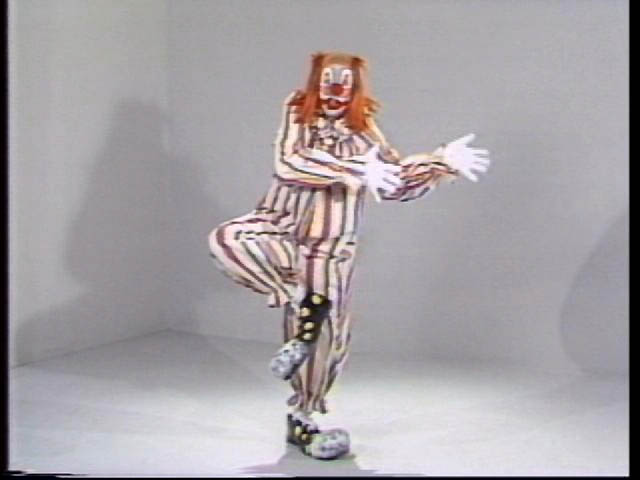
With this on my mind, although it might be stretching it a bit to call it relational aesthetics, I was interested to read about Decider's decision to send three real-life card-carrying clowns to view Bruce Naumann's Clown Torture installation at the Art Institute of Chicago, and to record their responses in real time (via Art21 and Bad at Sports).

'We’re probably deserving of this treatment,' said one of the clowns, and how right she was.

I believe I've mentioned before that clowns are no friends of mine. I dislike them even more than street theatre performers and people dressed in rabbit suits handing out chocolate eggs in the supermarket. 'Don't make eye contact!' I hiss to the small guy but it is always too late: we have to stop and watch the capering antics of some dick in a fur suit in order to get away with the crappy chocolate prize. To my mind, it's simply not worth it. (Clowns I put in the same unspeakable category as the supermarket menagerie, with an added fear factor. They really are creepy, and it's not just that Stephen King book I read aged 14.)

A public gallery should bring Naumann's Clown Torture to New Zealand. I would like to see it very much, and would consider it a bit of own back for all I have suffered at their enormous rubber hands.

Tuesday, March 17, 2009

Tail pipe

A couple more photos of Thomas Hirschhorn's Poor-racer, the One Day Sculpture in Sumner which I blogged about yesterday.

The first shows the twin exhausts customised with tin foil.


We presumed the foil-covered box in the boot in the second image was the obligatory ginormous subwoofer for the car stereo, but were corrected by curator Danae Mossman. It's actually the petrol tank: seems when cars are lowered, the petrol tank needs to be raised and welded into the boot cavity so it doesn't scrape along the ground and burst into flames. "Oh, OK," we said, and nodded. It was one of those strange art moments, standing in the cold wind of the Esplanade looking at a tin foil box and being instructed by an art history MA in the finer points of street racer customisation.

Monday, March 16, 2009

Gone in 24 hours


Drove en famille out to Sumner yesterday to take in Thomas Hirschhorn's Poor-racer, an event in the One Day Sculpture series perfectly conceived for Christchurch, the unabashed boy-racer capital of New Zealand. The sound of the suburbs is no longer lawn-mowers and leaf-blowers, as the recent promotion of the Ellerslie Flower Show would have you believe, but instead the "Psssht! Pssht! Varoommmm" of a customised Mazda Familia accelerating at speed. (Rather appropriate, I felt, that they turned Hagley Park into an enormous grassy carpark for the occasion of the garden show.) The small guy had complained about coming to see the sculpture, suggesting that a car covered in cardboard would be boring. "What is it? A car covered in cardboard? Did he use blue-tack or sellotape to stick it? It's a car, and it's cardboard. Not interesting."

But when we saw it, it was. Actually, the small guy's eyes lit up. It was parked nonchalantly about halfway along the Esplanade towards Scarborough Hill: a lowered modified car pimped with gigantic cardboard sideskirts, spoiler and insanely large hood scoop (or perhaps intercooler? I'm no expert, I just live here), and tin foil mags plus internal stabilising bars made out of what looked like toilet roll inners sellotaped together. The bonnet was raised to show engine parts 'chromed' with more tin foil. It looked driveable, but only just. Ridiculous and entirely wonderful, its obvious painstaking labour out of all proportion with the results, Hirschhorn's low rider was like a school project on steroids, its materials unfit for its ambitious conception. I couldn't decide if it was a monument to heroic failure, or just plain heroic. It reminded me a lot of Marie Shannon's photographs of her own 'unworthy objects', like her model house or the 'museum of cat fur'.

A coldish easterly had blown up along the beach, so the usual hordes of girls in bikini tops and board shorts and guys in wet suits a size too small queueing for the sole public dunny were conspicuous by their absence. We parked a couple of spaces down from the work and got out. A car slowed down as it passed by on the Esplanade, pale faces pressed to the windows.

There were a few people milling around the pimped cardboard car with a vague sense of purpose as we approached. An unlikely and diverse group. Half a dozen puzzled elderly punters who'd cut their Sunday constitutional short. A plump young guy with a curly mullet and nylon soccer shorts. The cultural attache from the Swiss Embassy; curator Danae Mossman; a couple of bleary-eyed young artists who'd assisted with gaffer tape and tin foil through the night, sitting on a tartan picnic blanket; the artist, tall and thin and dressed in black, chatting with all-comers.


You can always feel a tension at that kind of moment, looking at a new public work of art. The people already there have already bonded in a purposeful kind of way; as spectators or fabricators, they have formed themselves into a group united by mutual interest in the physical proximity of a peculiar object; the person who made it is standing there too; you arrive in their midst as a stranger; what will you bring to the mix? To get my bearings I walked round the car, and had a look at the detail -- the cardboard steering wheel, the fruit tray like a little mat on the passenger's side floor, the flames emblazoned in magic marker -- and took a few photos, and thought about it for a bit, and then was introduced to the artist. "Great work," I said. "Thanks for coming out." "Thank you," he said. I opened my mouth to speak, trusting that something vaguely intelligent and penetrating would come out. Suddenly I was aware of a strange sensation behind me. It was the small guy, who'd momentarily escaped from his father and had crept up to ping the elastic of my underpants. "Snap! Snap!" it went.

Hard to sustain the serious art thing after that, and probably just as well.

Here's the detail.

Passenger footwell. Windows taped for a crash.

Intercooler, mags, and fork flame pimping.

Customised upholstery and racing steering wheel.

Skirts and sponsors branding.

Here what the artist has to say. Thomas Hirschhorn:
"I am interested in the Form which is created by customising or tuning a car. The fact of personalising one’s own ordinary car in order to give it a unique individual touch is the revolutionary gesture of everybody, without exclusion. Customising or tuning is an act of resistance to the non-written laws of all kinds of exclusion. In the desperate and useless act of car-tuning I see a form of resistance throughout form. And as an artist - what can interest me more than Form?"

(Perhaps I should consider the underpants tweak as the small guy's own personal act of resistance to looking at art in the weekends.)