Showing posts with label earthquakes. Show all posts

Monday, September 17, 2012

The proper photographer


A photographer asked to take our picture yesterday. "I'm a proper photographer," he said. "Works in the public art gallery collection."

He was taking photos of Christchurch people in the ruined city. 

"Have you lived here forever?" he asked, looking down through the view finder. 

"No," we said.

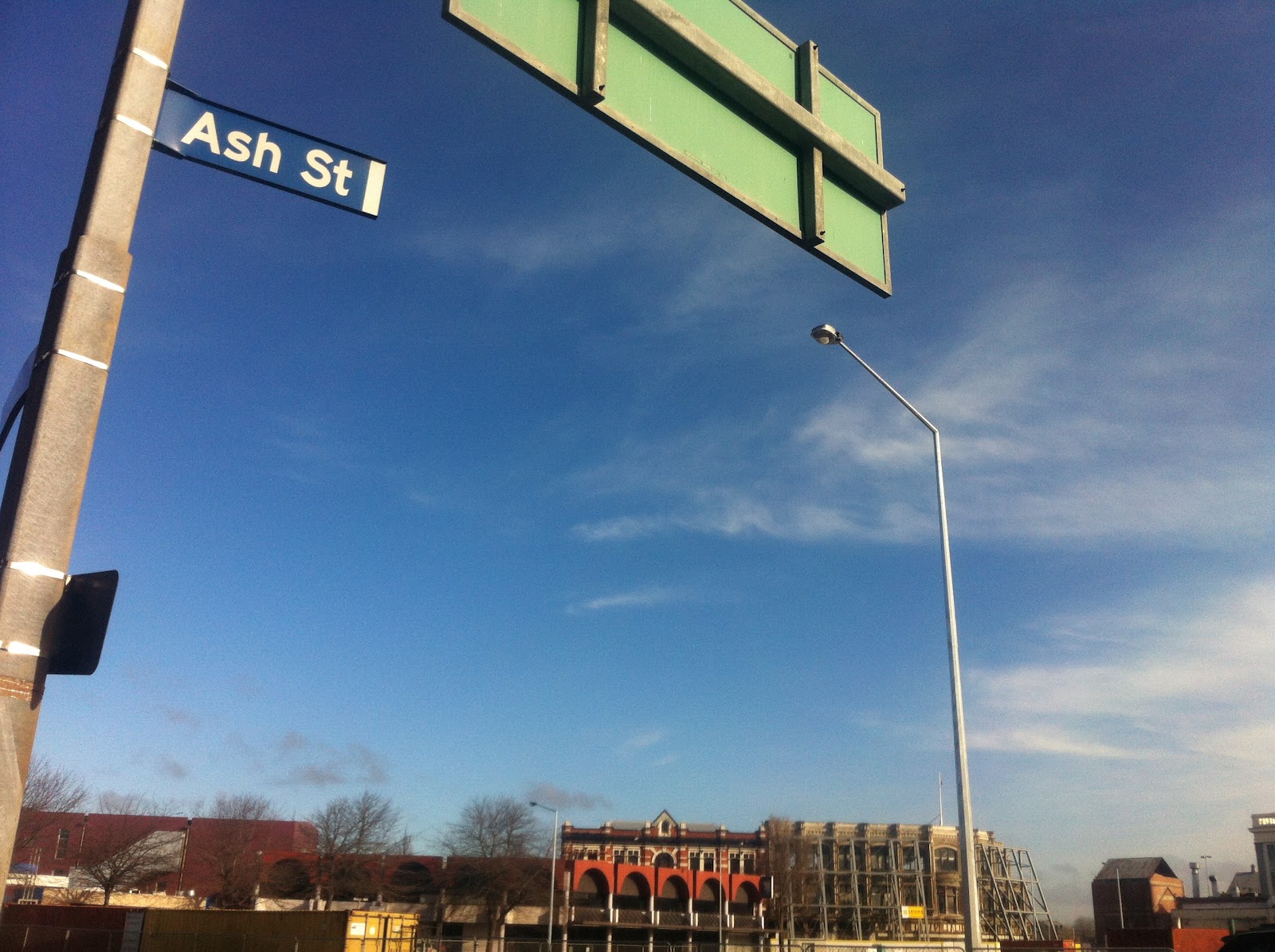
He made a portrait of us in front of the ruin of Shands Emporium, a small wooden shop built in 1850. Tyres were piled on its roof, holding it down. Loose stones shifted underfoot. The shop looked like an ark, battered after a long journey at sea. The carpark was bordered with hurricane fencing and white dashes like a mayday signal. The children held our hands, looked at the camera.

Just one more, he said. I'll shift my camera and one more. Closer together. Last one coming. Done.

Thursday, July 5, 2012

Blocked

Last night I watched TV3's premiere of The Block NZ. It's a DIY home renovation reality show based on an Australian model in which four couples compete to do up dilapidated houses (or as TV3's website had it, "depilated homes"*, which makes it sound more like The GC). The first episode appeared to consist of a half-hour commercial for Bunnings. 


 These are the four houses the contestants will live in, and renovate, over three months. Clearly the art department has been hard at work with their crowbars.


With tarps on the roofs, holes in the walls, iron boarding up windows and piles of bricks and rubbish in the yards, The Block's derelict doer-uppers look like half of Christchurch, nearly eighteen months after the  earthquake, where fixing houses is rather more critical than entertaining. 


Not wanting to be too mealy-mouthed about it: but at the very least, it seems like a wasted opportunity, doesn't it.


*Disappointingly, I see they've now fixed the typo.

Wednesday, July 4, 2012

The box of lost names

Central London, 1961.  
Photographer: Charles W. Cushman. Charles W. Cushman Photograph Collection.
Via The Retronaut.

My brother and I are second-generation London migrants. We were born in the West Country, and never lived in the capital, visiting only as tourists; but the cultures of the East End and the streets of North London informed our home life. It has only been recently that I have come to understand how much.

My parents, competitive, critical, fiercely intelligent, were beneficiaries of the post-war British education reforms which enabled academically-inclined children from a wide range of social backgrounds to go to grammar school. Education propelled them away from London. Up, and out. It took my father nearly forty years to go back to the streets behind the Arsenal F.C. where he'd grown up, only to find it changed almost beyond recognition. He returned as a distinguished academic, a writer, a member of the Royal Society: and as a New Zealander. But as my parents accelerated away from the city of their youth, London was always there in the rear-view mirror, a vast and creaking hulk; a place of bomb-damaged row housing and ghostly pea-soupers, of rationed coal and Coronation flags, of dog races and tin baths and bread and dripping. When asked where I'm from, even now I find myself saying that I was born in Devon, but my parents are from London.

There are few photographs of my parents' youth in London. I imagine that few were taken. When I get out the box of family photographs and look at the pictures of London, they seem primarily historical and foreign, rather than familiar. They are not part of our experience. They depict a way of life that we never knew, though it coloured our own, 12 000 miles away. There is a small Box Brownie shot of my father as a baby outside on the street in a gigantic ancient pram, taken in 1941 at around the time the German air raids on London began to gather momentum; my mother, blonde, beautiful, aloof, sitting on a brick wall in her grammar school blazer in the mid-1950s; an Ektachrome picture taken a couple of years later outside the front door at Ferntower Road, in which my father, black-haired and bohemian, stands with my mother's family; everyone holds melting icecreams and looks either melancholy or mildly irritated. Those photographs contain clues to the culture of the family. In recent years I have understood many things by looking at them.

When you look at photographs of your parents' youth, you're not looking at people you know but at people whom you never knew; you respond less to their familiarity than to their strangeness. Recently I've re-read Roland Barthes's Camera Lucida—the book which inspired Sebald's Austerlitz—and have been struck once again by the passage in which, following the death of his mother, he spends an afternoon looking through the family photograph album. In the photographs which were taken during his lifetimeduring the span of his memoryhe finds only a likeness of his mother; it's not until he discovers a photograph of her as a girl of five in a winter garden that he is struck by her identity, which comes on him like a sudden rush of air. Like Proust's madeleine, the winter garden photograph raises an overwhelming tide of narrative. Barthes chose not to reproduce the image in his book. "It exists only for me," he wrote. "For you, it would be nothing but an indifferent picture." 

The photograph that I have reproduced above was taken by Charles W. Cushman in 1961, at the time my father was studying at University College and my mother was training to become a teacher. It is from a series documenting street life in London. The photograph was featured recently on the Retronaut site. When I saw it I held my breath. I've looked at it dozens of times in the past few weeks; the young couple sitting on the low wall by the fountain could be my parents. 

They're not, of course. My mother's hair was fairer; my father's features swarthier. When I blew up the image in search of proof its generalities disappeared. But there's something about the couple's mutual abstraction amidst the life of the city that I immediately recognise. Their heads are bent forward as if reading, the city around them forgotten, left behind. They are in the city, but the city is not in them. They are, to use Barthes's term, the punctum of the image; the point of its emotional resonance. But as the fountain plays behind them and the pigeons strut and the men in grey suits go about their business, the woman in the pink dress and the man without a jacket are somewhere else entirely.

The people in the photograph are not my parents, but they might as well be. But they are, perhaps, someone else's parents, and by now someone's grandparents; though their images are on the internet their names are lost to history. Their identities have become detached from their images. Their digital image is the contemporary equivalent of those old photographs you used to see in boxes outside junkshops; other people's ancestors, unnamed, abandoned, caught in "indifferent pictures" lost to memory and consigned instead to history. 

A few years ago I went to a talk by Cushla Parekowhai about Ans Westra's photographs of the communities up the Whanganui River. Cushla's parents had been the teachers at the school Westra photographed; they were out of sight in her photographs. Cushla named the children in Westra's images, restoring the identities to the portraits. At the end of her talk she handed everyone in the audience a 2B pencil and told them to go home and write the names of people on the back of their family photographs. She was concerned that otherwise their identities would be lost. I did what she asked. I was glad that I did. (I've got some more photographs still to name, great uncles and aunts and people further back that possibly only I know the names of, now, and only that because my mother told me. Perhaps while you are thinking of it you could get a pencil and write names on the backs of the old family photos in your box, too. And you might also think of doing the same for the digital images you upload.)

But if the couple in Cushman's photograph had been named (and who is Charles W. Cushman? His name suggests he is American, a visitor to London in the early 1960s) I would have never have recognised my parents in them. Cushman's photograph gives me an image of my parents as Londoners rather than as my parents. It sets them against the backdrop of the generic cityscape recognisable to a tourist such as myself, rather than the familiar city intimated by the detail of a front door or the brick wall of a back yard.

From the mistaken identity of Cushman's photograph I’ve understood something about the essential mutability and fictionality of the city itself. The mid-century London I have invented for my parents is not the city in which they lived, although it has many similarities. It’s a cultural fiction composed as much from novels and films and documentary photographs as from the reported experiences of my parents. And there are remnants still of that London culture, both real and imagined, in our family life here in Christchurch; odd patterns of thought and jokes and turns of speech which I've passed on to our children without even thinking about it. The experience of any migrant is that the life of the culture endures beyond the lives of the people, and is not confined to the specificity of a place. It changes, it adapts, it is passed on. It goes with you, wherever you are. 

Wednesday, June 20, 2012

Waters above, waters below

On Sunday we visited 'Waters Above, Waters Below', an installation by artists Hannah and Aaron Beehre at the Christchurch Art Gallery's temporary premises in Madras Street. (The Gallery is closed, like half the city, for earthquake repairs: it will reopen sometime in 2013.) To find the art you skirt the edge of the shrinking central-city red-zone, and park next to hurricane fencing surrounding a wasteland. There are few landmarks to give you your bearings. The location is familiar, but the place is not. A small sandwich board indicates a doorway. And then you climb an old wooden flight of stairs to the top floor, and pass through a hallway into a large darkened room: a camera obscura, in which the world outside is projected on the far wall.


The projection takes place in real time: what you see in the gallery is what's happening outside. A camera is connected to a projector by means of an infinity cable. The city is inverted. The camera is stationary; the clouds move across the sky, backwards, upside-down. When there's a nor'wester, aeroplanes pass over the screen, flying from right to left. Sometimes there's a helicopter, or a seagull. As night falls, the camera lens opens slightly to draw in the available light, and the picture expands to include a second street lamp. 


The room is on the upper floor of the old Bain's Warehouse, now occupied by NG Gallery. There is a fashion store, and a jewellers, on the floor below. But it's quiet. Upstairs the windows have been blocked out with a white wall, on which the outside view is inverted and projected. The floorboards hold the impressions of the heavy objects which have been stored there at various times in the building's life. Their dull sheen reflects the light of the projected city, its raw and haphazard contours dissolved into soft washes of colour: blue, ochre, fiery orange. The effect is painterly, abstracted; a Sutton skyscape as re-imagined by Rothko. There is a feeling of quiet and calm in the room: of duration, somehow, in a city whose material past has been largely destroyed. The Bain's building is one of the few left in this part of town. As we sit quietly on low benches at the back of the room, mesmerised by the slowly-changing panorama of the sky (a vast 'amniotic ocean'), I imagine watching the city fall all over again.


'Waters above, Waters below' is the title of the work; but there is no water in the projected image, which takes its title from a passage from Genesis:
And God said, Let there be a firmament in the midst of the waters, and let it divide the waters from the waters. And God made the firmament, and divided the waters which were under the firmament from the waters that were above the firmament; and it was so. And God called the firmament Heaven.


Outside the same clouds are travelling in the opposite direction, and the Edwardian facade of the McKenzie and Willis building, held up by massive steel props, looks like an ancient ruin. 


Life in Christchurch, post-earthquake, is characterised by a great and growing strangeness, as the unimaginable, the unthinkable, becomes a daily occurrence. Events that belong in the pages of fiction happen here everyday. Rivers have changed their course; the ground has opened to swallow cars on suburban streets; something approaching three-quarters of the buildings in the central city are being demolished; people on the hard-hit east side live in tents and caravans in sub-zero conditions. The Beehres' 'Waters above, Waters below' represents an attempt to come to terms with that daily strangeness; to make art which deals with the everyday alienation of life in the city.

Sunday, April 8, 2012

The people's plinth

Inspired by local art teacher Henry Sunderland's instructions in The Press, to celebrate Easter this year we made bunnies out of plastic milk bottles. (Henry Sunderland is the originator of the idea of putting flowers in road cones as a commemoration of the first anniversary of the fatal 22 February Christchurch earthquake.)


The big guy screwed the rabbits on to some short lengths of wood.


Then we went out and put them on road cones nearby our house.


The city is still littered with road cones, indicating the extent of the damage to roads and pavements and underground services, more than a year after the earthquake.


I think there's something really interesting going on here, which is expanding the definition of public art. The road cones, symbol of damage and endless dust and mud and dreariness in our post-quake daily lives, have been adopted by locals as The People's Plinth; a place for showing and enjoying the creative expressions of local people.

I look forward to the next participatory public art project. We'll join in.

Wednesday, February 22, 2012

River of flowers

All over the city today, to commemorate the anniversary of the Christchurch earthquake, people have been placing flowers in the tens of thousands of road cones which cordon off broken areas of the footpath or which mark particularly bad potholes in the road. It's a form of spontaneous public art.


For those unable or unwilling to attend the big public commemoration in Hagley Park earlier today, there were a series of small, localised commemorations across the city on the banks of the Avon. People brought flowers from their gardens, and placed them in the river and watched them drift.

At 12.51pm today I went down to the stream at the end of our garden with a bunch of flowers, and I sat on the bank for a while, and then I threw them in.


Tomorrow will be the same, but not as this is

Colin McCahon, Tomorrow will be the same but not as this is, 1958,  solpah and sand on board, Collection Christchurch Art Gallery Te Puna o Waiwhetu; presented by A Group of Subscribers, December, 1962

If Christchurch Art Gallery were open, at 12.51pm today I would stand in front of this painting by Colin McCahon and think about what we've lost, and what we carry forward with us.

Friday, January 6, 2012

"Love falls down and covers the people"

I'd meant to blog this much earlier, of course; put it down to what in the local vernacular is called "quake brain", a state of mind in which things are misplaced, forgotten, fall off the back of the desk, dry up, falter, and generally slip through your fingers. Quake brain (I loathe this and other chummy cliched coinings around Christchurch's natural disaster, but it's an accurate description, and I don't have other words for it) is a bit like that strange fog you experience in the first days and weeks after a baby is born, when shock and exhaustion and a new hypervigilance renders you temporarily a spectator in the world rather than a participant. You are out of sorts with the world; you have misplaced your agency; you sit, and wait, and watch, while around you the current of history keeps moving. I imagine "quake brain" is a modern term for a very old thing.

What I missed, in the fog and dust of the past few months, is a desire to publicly acknowledge a series of beautiful collaborations arising from the inclusion of my daughter's story 'This is about earthquakes' in the literature category for the annual Mix and Mash competition. I was very much moved both by the inclusion of the text by organisers Pip Adam and Fiona Rigby, and by the new works which were created as a result, inspired in part by my daughter's experience of the February earthquake in Christchurch.

Here are some of the remixed works derived from 'This is about earthquakes', with a short excerpt under each link:

Hera Bird's prose poem 'The Mountain' (from which the title of this post is, in turn, drawn):
"We want to believe that love will keep us safe. But love will not keep us safe. Love has no central nervous system. Love looks like it's wearing a white hat. The mountain is covered with love."

Megan Clayton's poem 'Untitled (This is about earthquakes)':


And Brooke Phelan's delightful illustrations:


Click through on the links above to read the new works. And you can read more entries in the literature category of Mix and Mash here.