Saturday, September 25, 2010

Fairly unacceptable


I came across this important document the other day: the New Zealand Broadcasting Standards' Guide to the Acceptability of Words on Television and Radio, 2010 [PDF].* It's an interesting index to the cultural changes in New Zealand society over the past decade, if you go in for that sort of thing. Or if you simply appreciate long lists of rude words published by a government body.

Comparison with a similar list issued by the BBC in 2006 is instructive: Britons and New Zealanders agree on the rudest word of all, but otherwise there are considerable cultural differences, most notably as regards the relative offensiveness of 'wanker', the taking of the Lord's name in vain (far more shocking in New Zealand), and the various Britishisms ('sodding', 'shag', 'spastic' etc) which don't merit a mention on the antipodean list. While saying 'bollocks' is still quite rude in England, apparently, it's no problem at all in New Zealand: the respondents to the NZ BSA's survey believe 'bullshit' to be far ruder than 'bollocks', and 'bastard' considerably ruder than both of them.

There's probably a thesis topic to be developed in an analysis of the social changes reflected by the unacceptability of words over time, or in an international comparison of the valence of unacceptable words: a kind of Big Mac Index to cultural vulgarity. I'm a bit busy at the moment, but I'd love to read it.

The trend is definitely downwards, however: what offended New Zealanders in 1999 hardly ruffles a feather today. Which begs the question, once again: if swearing is increasingly socially acceptable, and everyone's doing it, where's the fun in it?


*via Sacha Dylan.

Thursday, September 23, 2010

The Way We Lived Then

The golden kakapo from Canterbury Museum, detail from an installation by Ronnie Van Hout at the Robert McDougall Gallery, 2009, from the Snare/Mahanga exhibition


When we moved back here nearly four years ago, I found Christchurch like a ghost town. It wasn't so much that the city was dead, but more that it was UnDead, to me at least: after fifteen years away I encountered the ghosts of my former life around every corner.

I'd drop the small guy off at gymnastics out at QEII, and bump into my teenage self staggering out of the turnstiles after Sweetwaters South in 1984. I'd go for a checkup and recall that the Greek-pedimented medical rooms were built on the site where the Victorian Coffee Lounge—one of the only two establishments in Christchurch in the early 1980s that was (a) open at night and (b) not a pub, complete with greasy red gingham table-cloths and candles in Chianti bottles—once stood. I'd see the green substation box on Wairarapa Terrace and remember the 'Fendalton Graffiti Club' sign that was once written on the front of it. I'd drive past the casino on Durham Street and suddenly be spilling out of the Gladstone at closing time after seeing The Bats or The Verlaines, checking my watch for the time of the last bus home.

Bill Hammond, Watching for Buller, 1994

Smells would do it, too. I don't notice it at all now, but for some months the university library's characteristic smell—equal parts dust and sweat and sweet floor polish—took me back instantly to Orientation Week 1985: black basketball boots, black sunglasses, black tights, black Cleopatra hair. Christchurch Gothic. The ghost of my former self.

Tony de Lautour, Operation Overload, 2006, Ray Hughes Gallery

For some time after I came back to Christchurch I went about reeling with the Freudian uncanny of it all. Every experience, every view, was overlaid with the memory of another time in the same place. It was like old fashioned offset printing, the picture slightly out of register, or perhaps a badly-tuned TV leaving ghostly trails behind the actors. I seemed to have forgotten everything, but my life was being replayed in jerky fits and starts. Any walk or trip in the car would trigger the back story. It was exhausting. It was relentless. I think when I left town in the early 1990s I pulled the door closed behind me. I never expected to be back.

Detail of serpents on a park bench in the Botanic Gardens

We live a few hundred metres away from the site of my old family home, long since demolished. The suburb is so changed that it's hard to remember what it was like, back then; but sometimes when I catch the light a certain way the Tuscan McMansions with clipped box gardens like Legoland Hidcotes disappear and the old white-painted weatherboard villas my school friends lived in rise again, shaded by hundred-year-old rhododendrons and dense shrubberies of camellias.

Even now, of course, the Freudian unheimlich, or unhomely, is never far away here in the England of the South Seas.

Reconstruction of predation by Haast’s Eagle (Harpagornis moorei) on South Island giant moa (Dinornis robustus). Image by Ray Jacobs, Canterbury Museum.

On our way to school we pass the house where Allen Curnow lived in the 1940s. I told the children about this one day when we were standing outside, waiting to cross the road. "A very famous poet used to live here. There should be a plaque, really. He wrote a great poem about the giant moa skeleton in the museum." Then a little white terrier ran through the garden and jumped up on his hind legs against the low brick wall behind a laurel hedge. "We could call him Allen," said the small guy.

Having been here for four years we are beginning to put down some roots. A while ago the small guy and I wrote down all the dogs whose names we know and whom we see on their morning rounds while we're walking through the park to school. There's Bebe the gigantic Newfoundland; Duke the poodle; Teddy, and Charlie, low-slung plumy tailers of uncertain parentage and cheerful disposition; Bertie and Bunty the spaniels; Milo the chocolate labrador. There's one big white one we call the Polar Bear, and the Barker Brothers. You start to feel at home in a neighbourhood when you know the names of its dogs.

__

I wrote this post, on the difficulties of being at home again in Christchurch, before the earthquake. Since then many things have changed, along with the streetscape of the inner city and the skyline of our street: one of the oddest after-effects of the quake, for me at least, has been to finally make Christchurch feel like home.

Sunday, September 12, 2010

Dispatches from an earthquake zone

Some post-earthquake photographs I've taken in and around the city over the past couple of days.

I took the first series through the car window, driving past the old brick Methodist church on the corner of Rugby Street and Papanui Road in Merivale on Saturday morning. The crane is lifting off the spire.


Notice on the door of our favourite Christchurch cafe, C1 Espresso in High Street.


The historic facade of the McKenzie and Willis building, built in Venetian Gothic style. You can see the red 'unsafe' sticker at lower left. While we watched, a man in fluoros and a hard hat appeared briefly in an upper window. He was welding a steel support structure in place. Above the corbels on the second storey, you can see the metal bracing which has been temporarily installed in the hope that this building, one of the architectural treasures of Christchurch, may be saved.


The army guard Tuam Street, a no-go area. In the background behind the bike shop is the 132-year-old Odeon Cinema, the last surviving historic picture palace in the central city. (Of course, it wasn't the earthquake that knocked down the others, but short-sighted development.) Originally built as a theatre, I think for vaudeville, the 700-seater Odeon closed as a cinema in 1983 (the last movie I saw there was Time Bandits), but has been remarkably well-preserved. There have been moves to reinvent it as an arts venue, but I'd rather see it returned to its glory as a movie theatre: it could be Christchurch's version of the Embassy or the Civic.


Meanwhile may I recommend a new blog, written by my friend the musician/academic Ed Muzik/James Dann: Rebuilding Christchurch.

Saturday, September 11, 2010

The aesthetics of earthquakes

I find it comparatively straightforward to write about nonsense, as will be evident to even the most cursory reader of my blog. My speciality is the art-inflected trivia that I stumble across in everyday life, which is a foil to the slightly bigger brain work that I do elsewhere. My subjects are multiple and various, and usually involve the moments of collision between two worlds—the high-minded and the low-brow—which I find particularly amusing or noteworthy. (The politics of aesthetics, you might call it, if you weren’t especially familiar with Jacques Ranciere.) The painting of the two dogs in Good Fellas; the social history of British TV’s Testcard pattern; the small guy’s foray into the western literary genre; the need to bring speculation on the Walters Prize under the TAB’s auspices; the problem with stairs at dealer galleries. Nothing is too small or too insignificant to be magnified and horribly distorted by my smeary blogging lens.

I find it much more difficult to write about serious things.


Manchester Street. Photograph by Christie Douglas

Like the massive 7.1 magnitude earthquake which struck the Canterbury region of New Zealand early last Saturday morning: definitely, A Serious Thing. The earthquake itself took apparently only 40 seconds, although each second was interminable. When I think back to it now—almost a week’s passed—I see that those 40 seconds represent a faultline between two different worlds: the time before the earthquake, and the time after it. The land itself has shifted more than four metres sideways, and things have changed.

We were woken at 4.35am by a loud bang, like an explosion, and the house violently shaking. It was the darkest part of the night, just before dawn, and we were deeply asleep, but snapped instantly awake, out of bed and running fast and low with some ancient atavistic part of the brain directing the body's response. We were asleep, and then we were on our feet, in motion. Wordless, we ran for the children. On the way to the toddler’s room, an old sun porch at the other side of the house, I could hardly stand: the floor was pitching and tossing like the deck of a ship in a storm. The noise of the quake was tremendous, a low, insistent, growling roar which mounted in intensity to an unbearable volume. There was the distinct sense of something dark, and massive, and indescribably violent, advancing on us at high speed.

We live in a two-storey weatherboard house built in the late 1920s, not far from the railway line. During nor’westers, we can hear the late-night freight trains hooting as they pass through the level crossing at the shops. Sometimes we go for a walk along the track the council has made alongside the railway line, down to Mona Vale to feed the ducks and back again. A few months ago a freight train came past when we were on the path, and the kids and I flattened ourselves against the bushes, overwhelmed by the noise and bulk and speed of the locomotive in such close proximity.

That’s what it felt like, a bit: a freight train attempting to drive itself at speed through the house. As I stood clinging to the doorframe, the toddler in my arms, every window in the house rattled in its frame simultaneously; I was dimly aware of the smashing of ceramics and glass downstairs; and bricks rained down on the roof directly overhead, as the first of our old tall late Arts and Crafts chimneys collapsed. The lights flickered once and died as the power went out. It was pitch black. The house was shaking so brutally that it appeared to be tearing itself apart. After a while, I understood that the back of the house might well disintegrate. It seemed impossible that it was still standing. That was the moment that I thought that our number may well be up. This is it, I thought.

But it wasn’t.


Afterwards, in the dumb silence that followed the earthquake, we all made our way downstairs, huddled together in the dark. The house creaked around us like a boat. Our feet were bare, of course, and the floor of the dining room was covered in shards of glass and smashed ceramics. We found a torch, which gave a pale gleam and lasted perhaps 40 seconds before going out. The big guy lit a candle. The power was off, and the phone and the water. We sat together on a couch, and waited for what would happen next. We didn't speak much. The big guy found a transistor radio and turned it on. "There's been a major earthquake in Christchurch," it said. When we went outside to check on our elderly neighbour, the stars gleamed cold and clear and distant. “Oh! The stars,” said the small guy. “I don’t usually see them.”

It was the big one, the one that every New Zealander expects; but strangely we had no notion of what would happen afterwards, in its aftermath. (I’ve read an opinion by a seismologist that says this wasn’t the big one, that at some point in the not-too-distant future New Zealand’s due for a quake of magnitude 8 or so: in which case I think that all bets are probably off, as anything much bigger than this may well have razed the entire city.)

Avonside Drive. Photograph by Christie Douglas

When I’ve read about earthquakes previously, like the one in Haiti in 2009 which was, they say, of a similar type, and size, to Christchurch 2010, I’ve imagined the horror of the quake itself, and then the heartbreaking recovery and clean up. But what really happens in the aftermath of a major earthquake is many, many more earthquakes, some almost as big as the initial quake itself. In the past week there have been more than 300 aftershocks, many of which have sent us scurrying into doorways or leaping from bed or diving under the reassuringly solid oak of our dining table. We’ve seen that an earthquake is not a singular event but a series of terrifying revisions of the initial shock, in which you relive that moment over and over again.

A notice the small guy made for our dining table

For a couple of days, our legs were rubbery, our knees wobbling. The floor rose to meet us. We weren't sure at times if the shakes were real or imagined. After some of the real aftershocks, ones in which the house banged and rattled and mortar rained down the roof, my hands were trembling so much it was difficult to hold my mobile phone, which didn't leave my hand or my pocket for five days straight. When we lost coverage for an hour or so on the first day when the emergency batteries ran down in the cellphone towers, I knew to expect it—and that it would be temporary—through what I'd read on Twitter. Twitter was an immediate source of necessary information, reassurance, companionship. Critically, my phone felt like a lifeline to the outside world, to places where the lawn wasn't covered in bricks and entire shop-fronts hadn't fallen into the street and the river hadn't changed its course and cracks so big a man could stand waist deep in them hadn't appeared in the roadway. A line to the old real life.


But here’s the strangest thing: after a while we stopped noticing the aftershocks. I was following them on Geonet, and on Twitter where a new sport of #earthquake poker quickly sprang up; but often there would be reports of fairly big ones that seemed to have bypassed our house entirely. It was as if we'd got our sealegs, as if we'd acclimatised to the moving ground underneath our feet. In the end, we were sleeping through major shocks.


The power came back on late on Saturday afternoon, but the water was off for three days in our neighbourhood. We drank lemonade and milk, purchased from a dark dairy teeming with people. We used baby wipes to wash the kids. When the water came on again, the pipes initially gave a great belch and dribbled a little: it was some hours later when the council workers down the road finally pulled themselves out of the huge hole they'd dug and pushed the earth back over the mains pipes that the water began to flow again. For some days after that, we had stockpots of water—the palest shade of light brown—boiling on the stove. There were news reports of people in welfare shelters coming down with dysentry.


The army rolled into town, to assist the police in cordoning off the ruin of the central city. One morning after a particularly wakeful night peppered with quakes, we lay in bed and listened as an Iroquois flew low over the house. There were Unimogs in Victoria Square, troop carriers stationed behind hurricane fencing on St Asaph Street. Bored young soldiers stood in front of the barricades. It looked like a military coup.

Manchester Street. Photograph by Christie Douglas.

Gradually reports and images of the ruined city began to come in to focus. The main architectural casualties seemed to be old brick commercial buildings—corner shops, and two- and three-storey late 19th century commercial buildings in the central city—and new rendered houses in the low-lying, swampy or sandy eastern suburbs. Parts of the city were flooded; other parts lay under six inches of a slimy grey silt, which had risen from the waterlogged ground in a process of liquefaction. Houses were cracked in two, or had been moved several inches from their foundations, or were leaning at crazy angles. When I finally ventured out of the house to take the children to the park, it was obvious that there hardly a chimney left standing in our suburb. There were piles of bricks in gardens and driveways and on grass berms.


The second of our chimneys hung on through all those days of major quakes by a single corner of a single brick, threatening to come down at any moment. It was a distinct relief when an extremely intrepid builder arrived to demolish it, roping himself through a window like an alpine climber.

Up on our roof, 6 September 2010

It's classic Maslow's hierarchy of needs stuff: after the power came on, and the water came on, and it seemed that perhaps the aftershocks were finally slackening off a little, our minds turned to the rebuilding of the city, and what it might look like. And critically: who might profit from it. There are many, many hard questions to be asked of politicians and planners and developers in the days ahead. There is also an extraordinary opportunity to reimagine the city all over again as an inspiring place to live: the truth is that it was damaged by pecuniary private interests and inadequate planning regulation long before the earthquake hit. A week after the earthquake, it strikes me that it would be a fine legacy for the next Mayor to make the City Beautiful beautiful again.

Just as there are no atheists in a foxhole, there’s little concern for the politics of aesthetics during an earthquake. That comes afterwards.

A crane driver plucks a chandelier from the wreckage of Robertson's Bakery on Victoria Street, to the cheering of the crowd. Photographs by Donna Robertson

Friday, September 3, 2010

Beer, Art and Philosophy

Image: Drinking at the Hammer Museum, with Ed Ruscha behind the bar and Tom Marioni to the far right. Credit: Michael Robinson Chavez for the LA Times.


‎"The act of drinking beer with friends is the highest form of art." San Francisco artist Tom Marioni, author of a memoir entitled Beer, Art and Philosophy, has put together a series of beer-fuelled art happenings since 1970 which have taken place variously in his own studio, museums, and neighbourhood bars. A show of his work (and five accompanying invitation-only beer salons, at one of which his friend Ed Ruscha tended bar), has just opened at the Hammer Museum in LA.

The public are invited to a performance later in the month called 'The Beer Drinking Sonata for 13 Players', in which players blow into the bottles after each sip, so that the tone -- so to speak -- gets progressively lower and lower. (Have a feeling I might have seen something similar done in a student flat in Christchurch in the 1980s.)

When asked by writer Jori Finkel if he agreed with Marioni that drinking beer was the highest form of art, Ed Ruscha commented: "I don’t know about a form of art; a form of life maybe. But you can call anything art, and that’s Tom’s thing. And I like the beer part of it."

Wednesday, July 7, 2010

The Scream

In search of a quick snack, I went out to the kitchen in the half dark and cut a slice of bread. When I saw my plate in the light, I didn't really fancy it.*


And in bed later, I swear I could hear the scrape of the bread knife against the carpet as the tiny evil Bread Man pulled himself up, stair by creaky stair.

Ree! Ree! Ree! Ree!


*Unlike the time Johnny Cash, or possibly Beethoven, appeared on a corn fritter, which went down just fine.

Thursday, July 1, 2010

Lino Types

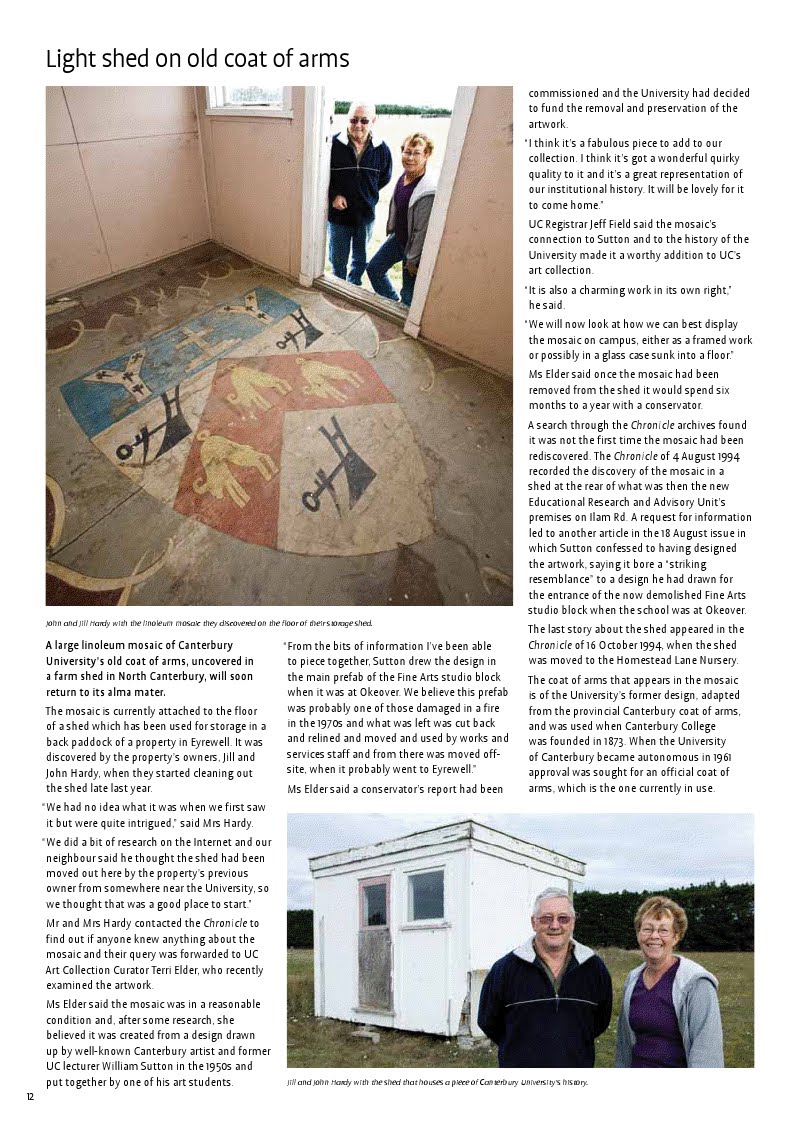
There was news of an interesting cultural discovery the other day in Canterbury: the old coat of arms of the University of Canterbury, designed by the artist Bill Sutton and made in lino by Sutton and his students from the School of Fine Arts in the 1950s, has been painstakingly restored by conservator Emily Fryer after being found in a shed.


The shed, on a private property in Eyrewell, was believed to have been constructed from part of a pre-fab in which the art school was housed at the Ilam campus (the art school was famously the first department to move from the town site, and the last department to receive its own purpose-built accommodation).

Here's a photograph of the original building, after the catastrophic fire which gutted it in 1975:


And an image of one of the lecturers' offices (more photographs at Digital NZ):


In its restored state, the coat of arms includes a burn mark, presumably dating from the art school fire. It seems to have originally been designed by Sutton for the floor of the art school's entrance, and was superseded in the early 1960s when the University became autonomous and changed its crest. Thereafter it's been lost and found a few times over the years in various sheds around the university campus, but following its restoration is going to be formally accessioned into the University's art collection, and is likely to be set into the floor in one of the new buildings at the Ilam campus. It's good to see the university treating its own art history with such care and seriousness, and I'm looking forward to seeing the coat of arms when it's exhibited later this year.

It reminded me a great deal of the similar crest set into the floor of my old high school, featured in Peter Jackson's Heavenly Creatures. As I remember it, the shot showed the girls' lisle-stockinged legs and clumpy brown shoes flowing like water around the crest: they were forbidden to tread on it, as were we, forty years later. (So of course everyone did walk over it, whenever they could get away with it.) I don't know who designed and made Girls High's one, which is still set into the floor in the old building, now used as a community facility: the ribbon is nice, but it certainly doesn't have the attenuated elegance of Sutton's design for the university. Wisdom and truth girls, wisdom and truth. And get your dirty great feet off the crest.


Image from Heavenly Christchurch.

Wednesday, June 30, 2010

Hammond Eggs

Andy Warhol had soup for lunch every day for 20 years. His favourite home-cooked dinner was turkey and potatoes, "because it looked so simple and clean". Picasso liked ancient eggs, stilton and preserved ginger. Edward Hopper was partial to "cans of the friendly bean". Jeff Koons served his favourite food, tuna burgers, at his 50th birthday party. And while Louise Bourgeois had a lifelong fondness for the humble oxtail, at one point in the 1990s Tracey Emin was on 70-100 oysters a week.

What these artists' snack preferences have in common (with the possible exception of Louise Bourgeois's, as oxtail takes a bit of stewing; but then again she was extremely well-organised) is a lack of fuss and no need for lengthy preparation. As Jo Hopper, Edward's wife, told the compiler of a Greenwich Village cookbook who'd approached them for a recipe: "We feel that where there's too much fussy cooking there isn't so much painting."

In a similar vein, here are two tasty no-fuss snacks enjoyed by Lyttelton's favourite son, the artist Bill Hammond, and Jane McBride. I do like to think of Buller's Table Cloth being painted with the help of a fortifying beetroot buttie.


From Harbour Kitchens: Celebrating Lyttelton, Its Food and Its People, Lyttelton Main and Lyttelton West Schools, 2009. Introduction by Roy Montgomery.

Wednesday, June 23, 2010

On the wires


A kereru, or New Zealand pigeon, photographed on the wires in Merivale this morning. With their short wingspan and plump square bodies, kereru are the Chinooks of the bird world. I've seen them a couple of times lately in the city, and heard the startlingly Deer Hunteresque whump!whump! of their wings overhead in the park.

Here's an image of kereru I came across a while ago, which might go towards explaining why we don't see them so often these days.


It was taken about 1900, and is a studio shot by Fairy and Plum of a group of hunters posing with their spoils: from the collection of Nelson Museum.

Tuesday, June 22, 2010

The G Word


I've been favourably considering the proposition that only people who haven't worked in an art gallery would find Gordon Ramsay particularly rude or stressful.


Likewise the Hotel Inspector. "Fuck the stupid bears! I don't give a shit about them." "It's just junk." "I loathe these burgundy napkins." Very mild indeed.


I'm currently a bit obsessed with Ruth Watson's latest televisual venture, Country House Rescue, in which she visits crumbling British estates of unbelievable loveliness, and spends a commercial hour bullying the stubborn, hopeless, be-corduroyed owners into adopting her unpalatable ideas to make the place pay. Each episode features some kind of event -- a wedding show, a country market, a cocktail party for tourism writers -- which looks in grave danger of falling flat on its behind, until a final bit of chivvying by Ruth gets it up and running. "Get those fucking posters away from the windows! For goodness sake!"

But again, there's nothing new here for art gallery alumni: the melee which ensues each week in Country House Rescue is not much different to the scene prior to the more stressful openings at public art galleries, an hour or so before the guests arrive. "Pick up those bloody sponges!" "Who's got the fucking labels?" "Look, just put all that shit in the cupboard: we'll sort it out later." "Oh, for Christ's sake, he wants what?"


I've been enjoying following, with half an eye, the live tweeting of Sarah Jessica Parker's new reality TV show, Work of Art, which launched a couple of weeks ago. The hapless contestants, fourteen would-be famous artists, compete for a solo show at a nationally-recognised museum (Brooklyn Museum, which has been in the news a bit itself lately) and $100 000 by making works from scratch in a range of mediums, a la Project Runway. The judges include the prominent and outspoken art critic Jerry Saltz, while a 'mentor to the artists' is Simon de Pury, art auctioneer.

Work of Art: The Next Great Artist sounds hilariously awful: the Twitter jury seems to be out so far about whether it's just complete horseshit or also vaguely worthy in that it brings contemporary art to primetime. I'm extremely keen to see it, but can't imagine in a million years that the New Zealand TV networks will pick it up, given their records of screening anything remotely smacking of art at deliberately inhospitable hours, relegated to the graveyard shift with religious programming and infomercials for vibrating exercise machines. Perhaps it could be franchised here, though? There'd be a few decent contenders for the various critic/judge/mentor parts, but the Saltz role would surely be a shoo-in.

I think what I'd really like to see most of all rather than artists duking it out is an Art Gallery Rescue, where an ailing institution calls in a tough-talking Mrs Fixit to increase its audience and critical credibility. Compelling viewing.

Monday, June 21, 2010

What we don't say


The other day I found myself in the difficult situation of needing to explain to the small guy the difference between swearing and other kinds of dubious language.

"What about 'you dick'?" said the small guy. "Is that swearing?"
"Um, no, not really."
"Loser?"
"No."
"Fool? Cretin? Idiot?"
"No. They're not very nice, but not swearing."
"Bugger?"
"Yes, that's a swear word."
"Really? I saw it written on the back of a jeep."
"Well," [mentally cursing Saatchi & Saatchi Wellington], "maybe people used to think it was a swear word more than they do now. But anyway, you can't say it."
"What about buttocks? That's a rude word."
"No, buttocks is OK. It's medical."
"How about bloody hell? Ron Weasley says it in Harry Potter. Bloody hell, Harry. Bloody hell. Bloody he-e-e-e-ll."
"..."
"What? I'm just saying what Ron Weasley says."

This is the sort of conversation that you can never in a million years imagine yourself having, before you have children. Then you have this sort of conversation every single day.

In the end we settled on a satisfactory three-part classification of language into 1. swearing; 2. normal; and 3. NSFS, or Not Safe For School, which includes what used to be known as vulgar language, or language not used in polite company, both of which definitions were useless when I tried them on the small guy. "What's polite company?" he asked, as well he might. Finally, Words We Don't Use At School hit the spot. "Oh yes, I know: once J called D & I 'dickies' and Mrs F said 'That's not school language.'"

The British media regulator Ofcom recently published some quite hilarious research concerning the TV viewing public's increasing tolerance of bad language: apparently "loony", "nutter", "poof", "lezza" [?!], and "Jesus Christ" are unexceptionable and socially acceptable at any time of day, while Anglo-Saxon epithets of all perusasions are fine after the watershed. I found it all a bit sad, really: what's the point of swearing if it's socially acceptable, I ask myself? It's almost enough to make you knock it off.


Clearly we are all going to hell in a handbasket, when you compare Ofcom's list of currently acceptable foul language on TV with this list reproduced by Gordon Mirams in Speaking Candidly, his social history of the movies in New Zealand, published in 1945.

The following collection of unacceptable words was known as the 'Hollywood List'.

WORDS AND PHRASES TO BE OMITTED FROM ALL PICTURES

Alley cat (applied to a woman)
Broad (applied to a woman)
God, Lord, Jesus, Christ (unless used reverently)
'Fanny'
Fairy (in a vulgar sense)
'Fire' - cries of
Goose (in a vulgar sense)
Hot (applied to a woman)
'In your hat'
Lousy
Nuts (except when meaning 'crazy')
Razzberry (the sound)
Tomcat (applied to a man)
Buzzard (too similar in sound to bastard)


WORDS AND PHRASES INVARIABLY DELETED BY POLITICAL CENSOR BOARDS

Bum (England)
Punk (England)
Stick 'em up (US and Canada)
Shag (British Empire)


Of these, I think 'in your hat' could definitely make a comeback. Might even be safe for school.

Sunday, June 20, 2010

Cultural Fogeyism

Frances Hodgkins, Pleasure Garden, 1932, watercolour, Collection of Christchurch Art Gallery Te Puna o Waiwhetu


The Pleasure Garden Incident -- as it's known to history, like the title of a novel Robert Ludlum deemed too fruity for publication -- tore a mighty rift through Christchurch's art world of the late 1940s.

Following Frances Hodgkins's death in 1947, the British Council sent six of her late works to the Canterbury Society of Arts for exhibition and potential purchase. Nearly three years of ridiculous argy-bargy ensued, as a battle was fought over the purchase of a single work, the Pleasure Garden. The progressive and conservative camps of the local art scene squared off against one another in public meetings and the correspondence pages of the newspaper, while the general public looked on with indignation and incredulity. The Garden City continues to use this method to conduct its cultural affairs: the Arts Centre's Heritage Carpark, anyone?

On the one side of the Pleasure Garden stoush were the go-ahead artists like Doris Lusk, Theo Schoon, Olivia Spencer Bower, Colin McCahon, and William Sutton, who wished the city to have the work. On the other were the keepers of what McCahon described in a vituperative letter to the paper as the 'three dead tombs of art' (the university's art school, the city's public art gallery, and the local art society); whose spokesperson, painting lecturer Cecil Kelly, suggested of Hodgkins's work that "The tone is not good. The colour is not good. And the composition is all over the place. A child could do it."

(Mind you, the progressive types were just as incendiary: one described the city's Robert McDougall Art Gallery as "a badly arranged museum of Victorian art ... that had died when photography came in", while another apostrophised Christchurch itself as a "curious and amusing backwater in the world of art".)

In yesterday's Press, Michael Vance looked at the incident in his 'The Way We Were' column, concluding that the row was not over one painting, but represented something much larger.

"It was the moment when cultural fogeyism, which had dominated Christchurch art since the colony's foundation, was first defeated, and, despite occasional stirrings, it has remained defeated."


And there we have it. Christchurch, New Zealand: free of cultural fogeyism since 1951.

Wednesday, June 9, 2010

The Rules of Sculpture; or, Dancing on the Table


In New York in 1991 -- which is quite a long time ago now I think about it -- I visited the Sonnabend Gallery in SoHo. I had no idea what was on. When we got there, the walls were covered in a series of very large, slightly expressionist pencil drawings on paper. The paper was rippled, in places, and a bit crinkly, like a newspaper that's been left in a potting shed for a year or two. The drawings looked familar, but I couldn't immediately place them. We shuffled from foot to foot, and looked around, but there were no clues. An extremely personable gallerist came out and put us out of our misery: "Gilbert and George," he said. "The same exhibition that they showed here in 1971. Singing Sculpture. They remade it for us. They were here last week. Look, here's the table they stood on," and he gestured towards it.

We turned as one and gazed at an empty wooden office table.

We'd missed Gilbert & George by a week, but it might have well have been twenty years. We imagined them standing there on the table, dressed in their suits, their faces painted bronze, twirling their canes and slapping their gloves, miming to 'Underneath the Arches' played over and over and over again.

When they performed the Singing Sculpture in 1970, they 'sang' for up to eight hours a day, standing side by side on the table, keeping going no matter whether anyone was in the gallery or not.* 'Underneath the a-a-a-a-arches', over and over again, accompanied by classic vaudevillian gestures, like the mindless repetition of the work on an assembly line in a factory. (My grandmother, who grew up in the East End, had a similar propensity to break into 'Underneath the Arches', an old music-hall standard by Flanagan and Allen, at the drop of a hat. I think once or twice through was the most she'd do in one go, though.) Written in 1932, the theme of the song is poverty and homelessness, as voiced by two tramps:

Pavement is our pillow
No matter where we stray
Underneath the arches
We dream our dreams away


John Cake and Darren Neave, aka The Little Artists: Gilbert and George's Singing Sculpture, 2005, Lego and plastic display cube.

George commented later:

"In our little studio in Wilkes Street in Spitalfields, we played that old record 'Underneath the Arches'. We did some moving to it, and we thought it would be a very good sculpture to present. That, in a way, was the first real G&G piece. Because it wasn't a collaboration. We were on the table as a sculpture, a two-man sculpture."

Gilbert and George were in Sydney earlier in the year to celebrate 40 Years of Kaldor Art Projects at the Art Gallery of New South Wales: John Kaldor had originally brought them out to Australia in 1973 to perform the Singing Sculpture. Although the odd work has occasionally been shown in New Zealand as part of a touring international collection, I don't think that Gilbert and George have ever exhibited a body of work in this country, something I wish a public gallery would rectify quickly. (What I'd really like, of course, is to see them dancing on the table in their suits.) The place has been on their minds, though, albeit as a metaphor for the furthest reaches of civilisation: “We think that we should be able to make a sculpture that can address every man, woman or child, whether in Africa, New Zealand or anywhere,” they said in the late 1990s.

There's a lot to like about Gilbert & George: having worked hard since the debut of the Singing Sculpture to close the gap between art and their own lives, they are eminently, hilariously quotable, living works of art in dapper suits whose last names (Proesch and Passmore) have almost been lost to art history. They've lived in Spitalfields since 1968, documenting what they see on the streets while taking their thrice-daily walks to their nearby studio. Racism, sexuality, class consciousness, bodily fluids, booze, squalor, dumb jokes: "There's nothing that happens in the world," they've said, "that doesn't happen in the East End," which is pretty much what I understand from my own family's long history there. Amazingly, a series of images inspired by the graffiti they saw each day in 1974 was deemed too objectionable to be shown until 2002.


"We look at the raw material of life," said George. "We prefer to come out of the front door, it's been raining, there's a puddle there, there's a bit of vomit from a Chinese takeaway, there's a pigeon eating it, there's a cigarette end, and that's all there is. And then you know what it is."

Of their various manifestos and maxims for life, perhaps my most favourite is Gilbert and George's 'Laws of Sculptors', which should be standard operating procedure in every art school. (And may well have further useful application beyond the visual art world.)

1. Always be smartly dressed, well groomed relaxed friendly polite and in complete control.

2. Make the world to believe in you and to pay heavily for this privilege.

3. Never worry assess discuss or criticise but remain quiet respectful and calm.

4. The lord chisels still, so don't leave your bench for long.

Good advice, that. Better get back and do some chiselling of my own.


* Because I am a suspicious type, I've wondered how anyone can really be certain that G&G really kept on performing when the gallery was empty, but then I suppose there was someone else there, an anonymous assistant dropping the needle on the record over and over again; a Herculean labour almost commensurate with the performance itself, except the person could probably sit down most of the time, and pop out now and again for a cup of tea.

Thursday, May 27, 2010

Art threat


"The greatest threat to art is posed by Occupational Health and Safety regulations."

-- Adam Jasper, reviewing the 4th Auckland Triennial in Frieze.

Wednesday, May 26, 2010

Better than collecting dust

Lately our house has been gripped by collection-mania. The small guy has been furiously eating his way through groaning bowls of cereal, even to the point of regularly asking for Ricies and ice-cream, a dish of his own invention, for dessert. The object of his desire is Weetbix rugby cards, for which he has conceived a rare and burning passion. His conversational starters these days include such gems as "Would you like me to take you through all my cards in the order in which I got them?" and "Mum, I know you said I wasn't to talk about them again today, but I've been thinking, if I swapped Sitiveni Sivivatu..." and the plaintive "I really wish I hadn't swapped Richie McCaw with Edward... Do you think I could get him back?"*

When the big guy was sick the other week it fell to me to take the small one to soccer, which is the nearest I've got to a sportsfield since a regrettable foot-tripping incident on the netball court at high school. I am not generally considered a sporting type, nor I am one of nature's sports'-lovers, though I am married to one. The big guy has an uncanny ability to discover a test match just about to kick off, while seemingly innocently channel hopping: "Oh, look," he says, "Might just watch a few minutes." I open a book, although it's hard to concentrate over the yelling and drumming of feet. (I will admit to a slight relaxing of my usual anti-sports 'tude when Frank Bunce appeared on Dancing with the Stars.)

Buncey: The Samoan Robert de Niro


While the small guy had a terrific time running round after the ball in a mad puffing scrum of muddy little boys, and the other parents roared up and down the sideline barking instructions to their oblivious offspring ("Tackle him! TACKLE HIM! Oh, what's that! They're playing A STRATEGIC GAME! Get off, you showpony! etc), I stood under my brolly listening to art podcasts, giving the small guy an encouraging shout now and then when he hove into view and feeling, not for the first time, like a bit of a tosser. While the big guy is able to balance his enthusiasms for art and sport most effectively, I suspect I may have been born without the requisite gene. The artworld is a comfortable enough habitat, but on the sideline of the soccer field on a wet Saturday lunchtime I am a fish out of water.

The small guy's mania for rugby cards, however, is something I'm quite familar with. It's a look that I've seen in the eye of many art collectors over the years. The collecting bug is one that all public galleries depend on; the expansion of the New Zealand art market in recent years means that galleries are increasingly dependent on loans from private collectors to supplement monographic exhibitions. Many 'museum quality' works, as they used to be called, are now in private hands, and it's the job of public galleries to persuade the collectors to part with their works, temporarily, for public exhibitions.

Art collectors are usually interesting people to speak with, as -- like the small guy, who needs no encouragement whatsoever -- they'll often communicate wild and intemperate enthusiasm for the works they've acquired. They might have started with an anonymous painting bought from the school art auction, and end by waiting in the rain outside a top dealer gallery for an advance preview of an exhibition opening that night: the kind of exhibition which opens with the red dots already appended to the works. Arranging, distributing, and refreshing their collection, as well as acquiring new works, can take up a considerable portion of a serious art collector's time and energy.


The small guy, who is no fool, realised early in the piece that a competitive advantage was inherent in the fact that his little friends were keenest on Crusaders cards. He understood that if he were to collect another team, one less valued by his rabidly red-and-black mates, any Crusader cards he got would be more valuable as swaps. This proved correct: on several occasions, before rugby card trading was banned at school, he was able to negotiate two-for-one deals. He started to put together a collection based around the Highlanders ("Because they're a bit useless, and no one wants them") and the Chiefs, for ancestral reasons. Sentimentality got in the way, a bit: for ages he wouldn't part with George Whitelock ("He's hopeless, hasn't got any points, and I feel sorry for him.") Although not intrinsically different, or even rarer, some cards had a higher value purely because they were more sought after by those in the know. It was just like the art market.

The small guy got serious. He press-ganged his extended family into changing their breakfast-eating habits; found a couple of lost cards on the pavement; ate dozens and dozens of Weetbix; spent hours rearranging the cards and thinking of different taxonomies (positions, teams, cereal types, favourite-to-least-favourite, and so on); and was continually encouraged by his long-suffering mother to please introduce another topic of conversation. The collection steadily grew.

Poor old George Whitelock: we feel a bit sorry for him.

And then one day Charles came round for a playdate, with a bulging bag of swaps. Charles is a big maths brain; while the small guy, more language-orientated, is confident pronouncing tricky names like Mils Muliaina, Charles refers to all his cards by their number. Listening to their conversation was like watching a debate at the UN through the medium of simultaneous translation. A brisk session of horse trading ensued after afternoon tea. "Do you need Corey Flynn, Charles? Because I might be prepared to trade him for someone good." "Flynn, Flynn. Number 21. Yes. OK. What are you thinking?"

But something was amiss. It slowly dawned on the small guy that the enormous pile in front of Charles only represented his trading cards: his real collection was at home. It was essentially very dispriting. The cards are due to stop being issued in early June; it would be impossible for the small guy ever to catch up. (In vain we told him that Charles's parents teach at a boys' boarding school, where they must go through three hundred packets of Weetbix a week: no wonder he can hardly lift his bag of cards. It would be like comparing the collection of a public gallery to the works pinned up on one's fridge. No consolation, though, for the serious collector.)

The small guy put his collection away for a few days until an envelope arrived from his uncle with a few more cards (new ones! no double ups!), and his enthusiasm was rekindled. But it's been an interesting thing, watching the collecting bug develop in the small guy, and his knowledge of rugby consequently grow exponentially, in the way that an art collector's does, when they start getting serious about their subject. (As well as his intuitive feel for the 'market' in the cards. Terrible. Capitalism 101, for six-year-olds.) What's been most interesting for me, with no wish to further my own very limited knowledge of sporting heroes, is to discover that the kinds of behaviour that I'd previously put down to the specific enthusiasms of art collectors are in fact those of collectors in general. Whether it's the holy grail of a McCahon or of Richie McCaw's face on a Weetbix rugby card, it's the thrill of the chase that's the point.


*["No."]

Wednesday, May 12, 2010

Great spaces


I was listening the other day to a podcast of architect Guy Marriage in conversation with Lucy Orbell on Radio New Zealand's 'Arts on Sunday' programme. (Available here for a short time.) They were speaking about the architecture of the Adam Gallery, an institution which last year celebrated its tenth birthday. As they walked through the gallery, Marriage spoke about why he thinks the Adam -- designed eleven years ago by Athfield Architects -- is such a successful building.

It was an extraordinarily challenging site; a thin wedge of space between existing buildings, which incorporated an existing three storey staircase. The architects covered the staircase with black rubber, giving the Adam that tyre-shop smell I always love, and created a building with a variety of flexible gallery spaces. Very little of the building is seen from the outside, apart from the monumental blank north wall, pictured above, covered in zinc. When you enter the building, you have no idea what to expect. As Marriage walked through the gallery, describing what he saw, I recalled that sense of jaw-dropping surprise I had the first time I visited the building, at its opening party, coming through the squeeze of the front foyer gallery and turning the corner to peer over a three storey void. The grandeur of that enormous wall dropping away below the visitor is one of the great architectural experiences of New Zealand.

Here's how Guy Marriage concluded his walk-through:

"I guess people think that architects just design buildings. But my philosophy is that architects design spaces. And once we've designed the spaces then we figure out how to build the buildings that enclose the spaces. So it's very important to think about the space first. It's something as New Zealanders that we often forget. We don't have many grand spaces in New Zealand: we tend to have lots of little slices. So I really love it when we have a grand space like this that someone's taken the trouble to think about."

Julia Morison, wall drawing for 'Wall Works', Adam Art Gallery (showing lower level), 2009.

While I don't think I've ever seen an Athfield building that I didn't warm to from the outside, it seems to me that it's Athfield's use of internal space which is one of his great skills. There's a humanness to his designs, as well as frequently a sense of daring and functional grandeur. He creates spaces that people are comfortable to be in, to congregate with others and move through. I always think of the Wellington Public Library, as well as the City to Sea bridge, as a couple of his most successful spatial designs. Not only do they look beautiful, and reference the history of the place in which they stand, but they're used, happily and creatively, by many hundreds of people every day. The scale and grandeur of their designs are balanced with a concern for the way people use them and exist within them.

Guy Marriage's remarks on the paucity of grand internal spaces in New Zealand architecture got me thinking. He's absolutely right, I suspect, but there are a few. In addition to the Adam Art Gallery and Wellington Public Library, I thought the following might constitute the beginning of a list of great New Zealand architectural spaces, albeit a list rather biased towards art-related buildings and Christchurch. Each of the spaces below reveals that sense of functional grandeur which the Adam so epitomises; astounding on first encounter, yet ultimately accommodating of the human presence. I'd be interested in further suggestions.

1. The central dome gallery of the Sarjeant Art Gallery, Wanganui. 1932. Architect Donald Hosie of Edmund Anscombe and Associates.

2. The A1 Arts Lecture Theatre building at the University of Canterbury. (I don't know who the architect was.)

3. The Great Hall at Christchurch Arts Centre, 1882, architect Benjamin Mountfort.

4. Level 5 at Waikato Museum in Hamilton, 1987, architect Ivan Mercep.

5. The Britomart Project, 2008, architect Mario Madayag with Jasmax.

6. The Christchurch Town Hall auditorium, 1972, architects Miles Warren and Maurice Mahoney.